
Table of Contents
Managing employee attendance in Excel is one of the most common starting points for growing businesses. Whether you’re using an excel attendance tracker, a simple spreadsheet, or a detailed employee attendance sheet in Excel, it offers a flexible and cost-effective way to record daily attendance, track absences, and calculate working hours.
But as teams grow, managing attendance tracking in Excel quickly becomes time-consuming and error-prone. Manual data entry, lack of real-time visibility, and challenges in tracking remote or distributed teams often create inefficiencies, especially for service-based businesses where time directly impacts revenue.
In this guide, you’ll learn how to create a fully functional employee attendance tracker in excel step-by-step, including formulas, automation tips, and templates. You’ll also understand the limitations of Excel and when it makes sense to move to a smarter, automated attendance tracking solution.
What is an Excel Attendance Tracker?
An Excel attendance tracker is a spreadsheet used to record and manage employee attendance on a daily, weekly, or monthly basis. It typically includes employee names, dates, and attendance status (present, absent, leave), along with formulas to calculate total working days, hours, and absences.
Businesses use an employee attendance sheet in Excel to maintain accurate records, monitor attendance patterns, and support payroll calculations, without needing dedicated software. While it offers flexibility and easy customization, it relies heavily on manual updates and lacks real-time tracking capabilities.
Download Free Excel Attendance Tracking Template
1. Daily Employee Attendance Tracking Template
Download the online, shareable template in Google Sheets, create a copy of your own to start using.
Download the PDF version of daily employee attendance template.
2. Weekly Employee Attendance Tracking Template
Download the online, shareable template in Google Sheets, create a copy of your own to start using.
Download the PDF version of the weekly employee attendance template.
How to Create an Attendance Tracker in Excel (Step-by-Step)
Best way to track attendance in excel is by using an excel attendance tracker or spreadsheet simplifies tracking attendance, absences, and other attendance-related data. Here is how you can create a detailed monthly attendance tracker:
Step 1: Create A New Excel Spreadsheet
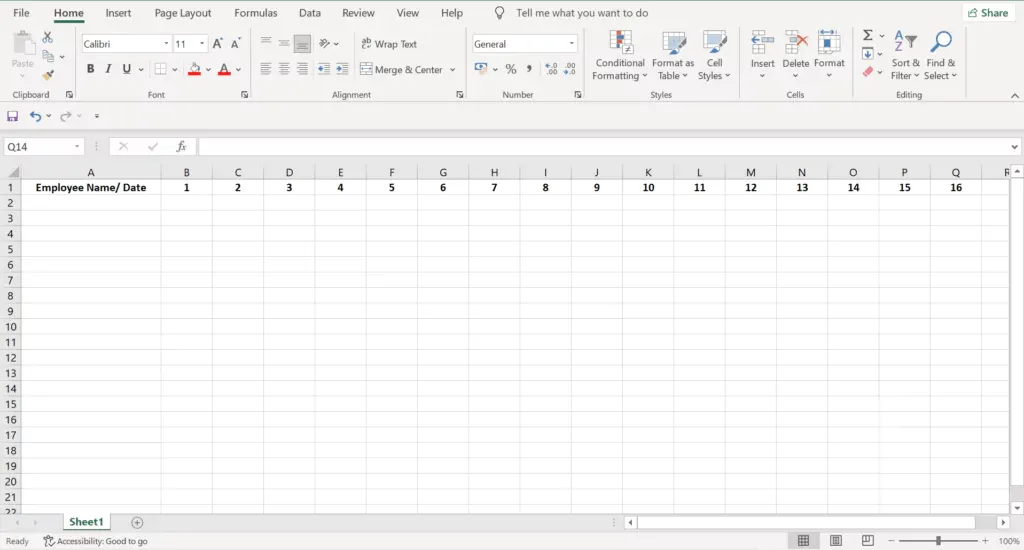
Make a new Excel spreadsheet with columns for each date in that specific month to make the attendance tracker.
Step 2: Set Up Column Headers
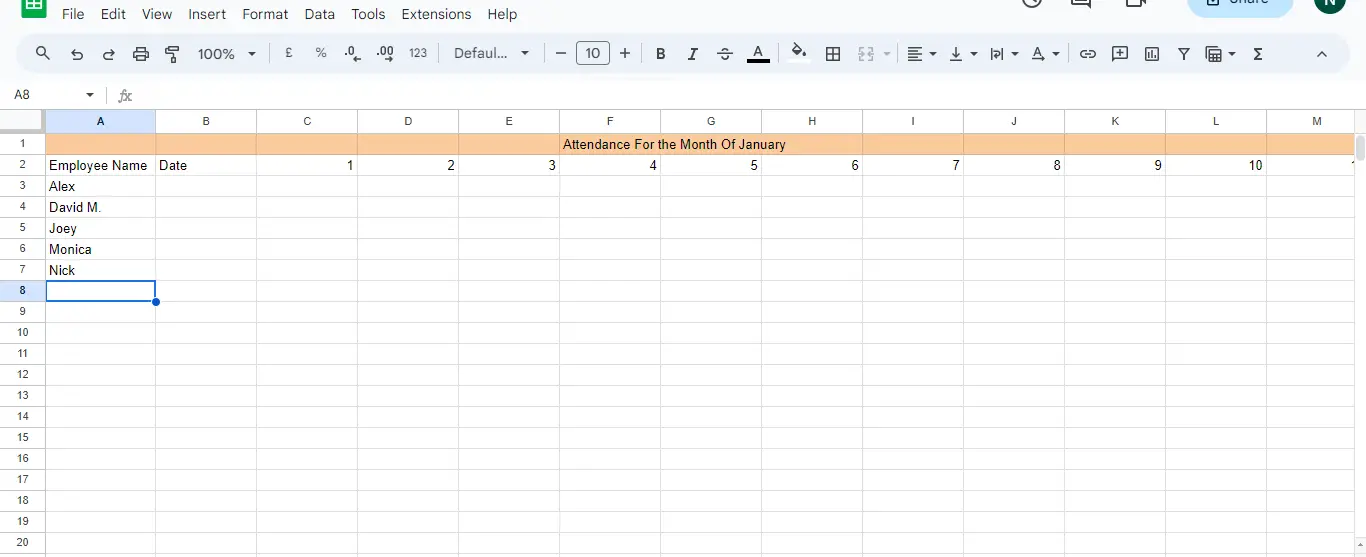
In the first row of your spreadsheet, create column headers to organize the information. You’ll need various columns to capture essential data:
- Column A: Employee Names – List the names of all employees in this column.
- Columns B onward: Dates of the Month – Create columns for each date of the month you want to track. You can manually enter these dates, or you can use Excel’s date functions to auto-fill them. This ensures that your tracker covers the entire month.
Step 3: Highlight Weekends and Holidays
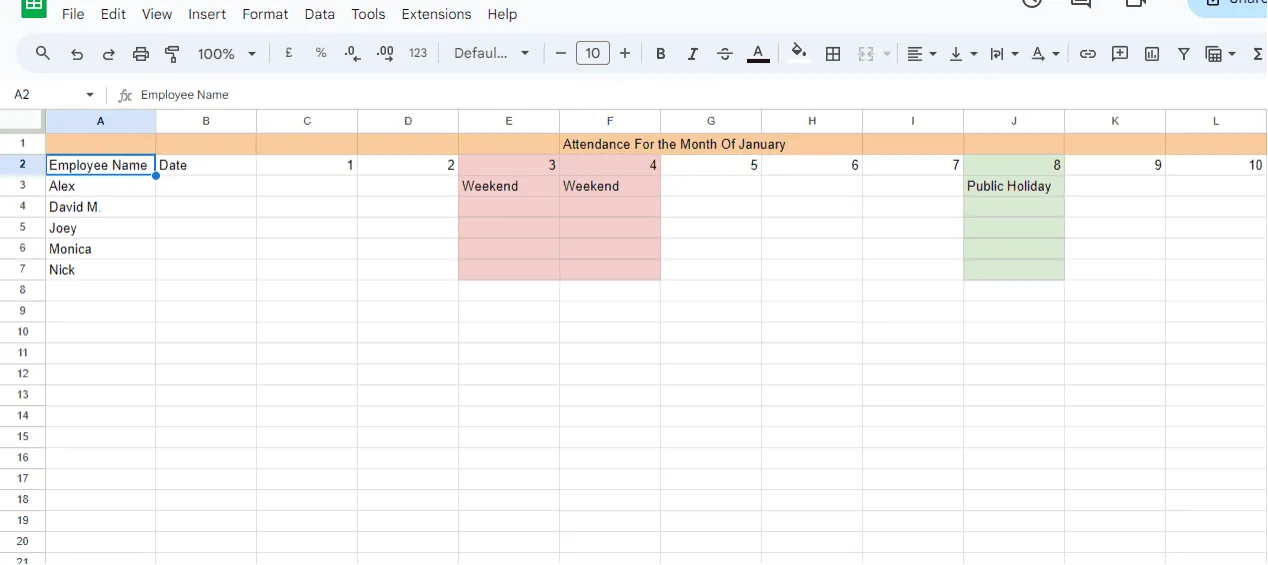
To distinguish weekends and public holidays from regular workdays, apply cell formatting:
- Select the cells corresponding to Saturdays and Sundays and use Excel’s fill color feature to highlight them, making them easily recognizable.
- Use a different fill color to highlight cells for public holidays.
Step 4: Implement Data Validation
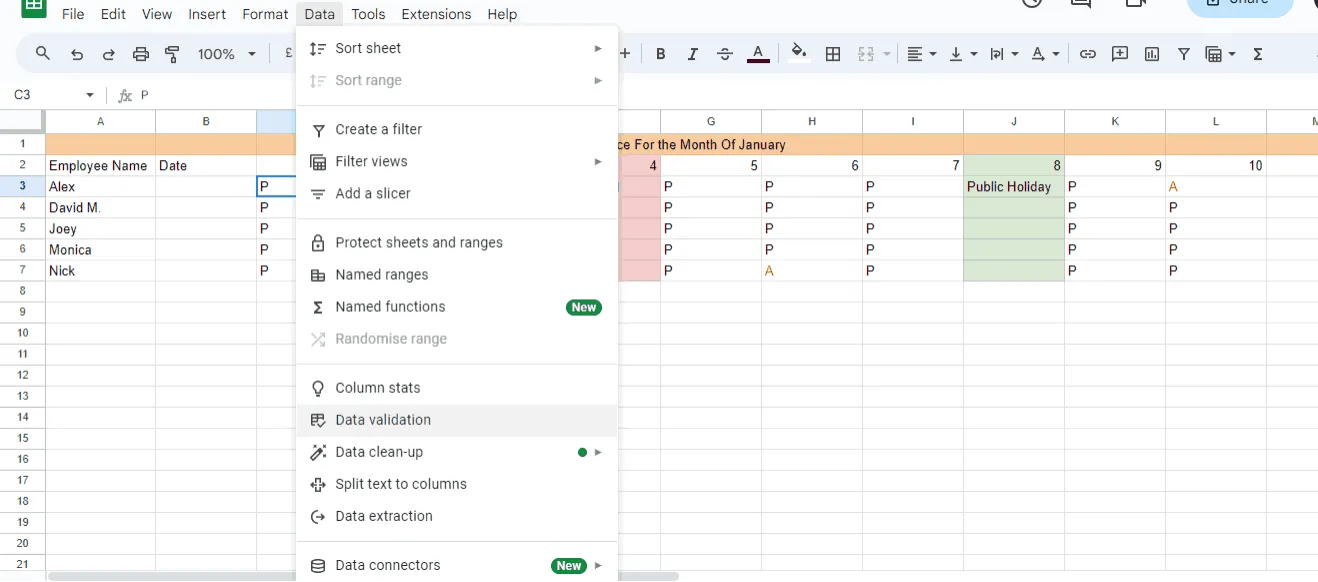
To maintain data consistency and accuracy, implement Data Validation to enforce specific rules for data entry:
1. Access the Data Validation feature by navigating to the ‘Data’ tab in Excel.
2. Create validation rules for the cells where employees will input attendance data. For instance, you can restrict them to entering keywords like:
- Present
- Absent
- Half Day
You can also set up rules for valid time entries, such as only allowing times between 8:00 AM and 6:00 PM.
Step 5: Lock Input Cells
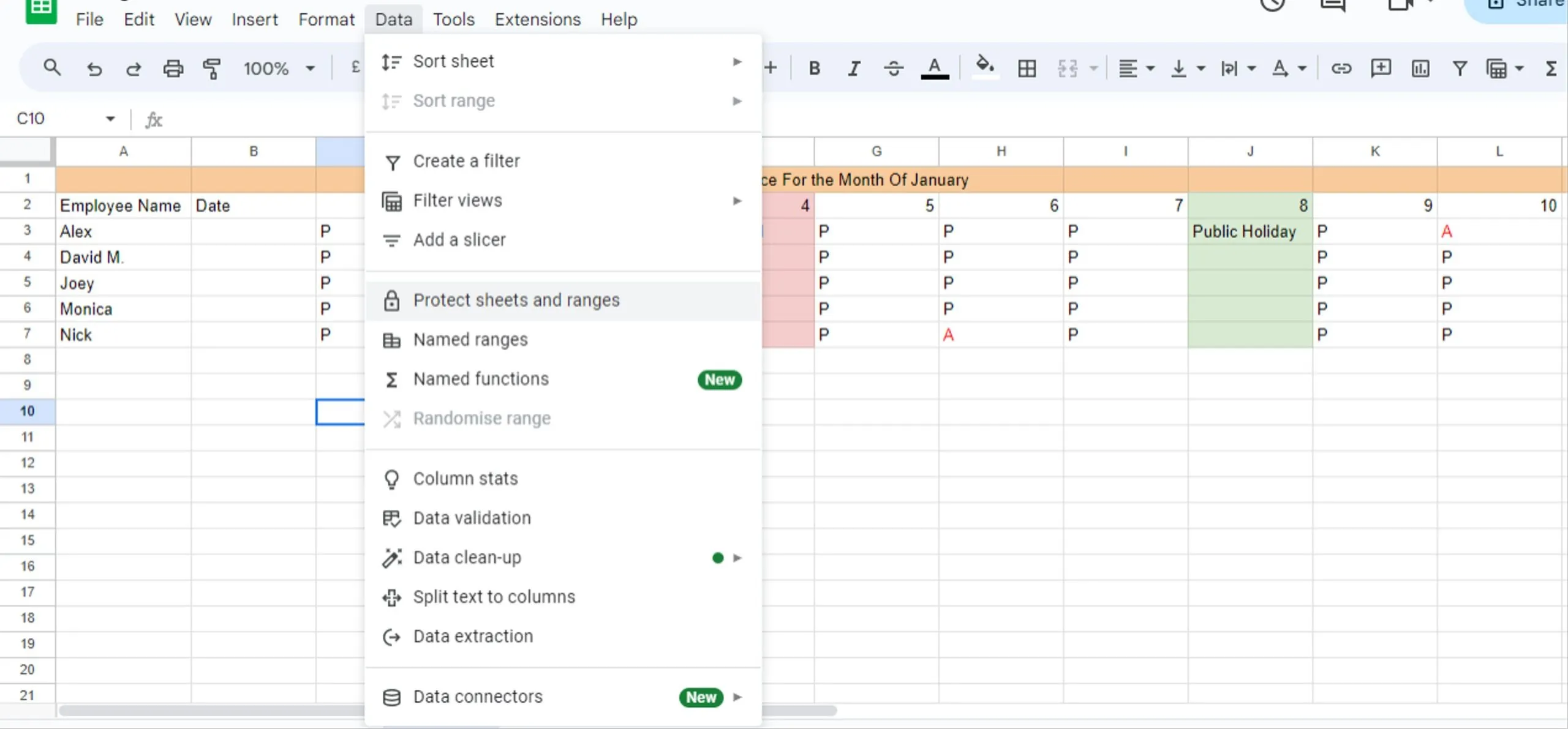
Prevent accidental changes to cells that shouldn’t be edited by locking them:
- Go to the ‘Data’ tab in Excel.
- Select ‘Protect sheets and ranges’.
- Protect all cells except those where employees must enter their attendance data. This ensures that only designated cells can be modified.
Step 6: Calculate Absences and Presents
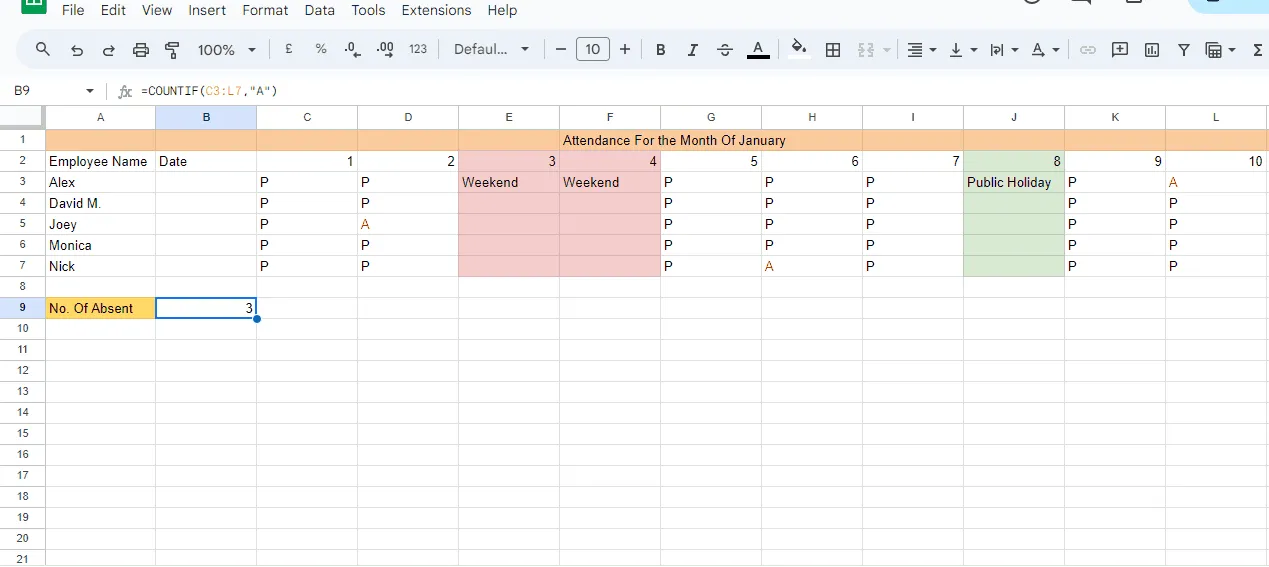
Calculate the number of absences and presents automatically by setting up Excel formulas:
- Select a cell where you want to display the number of absences and use the COUNTIF formula.
- For instance, if employee names are in column A, and the attendance data is in columns B to the end, you can use this formula:
=COUNTIF(C3:L7, “Absent”)
- This formula counts the number of times “Absent” appears in the specified range. Create similar formulas for calculating “Present” or other attendance criteria.
Step 7: Share the Spreadsheet
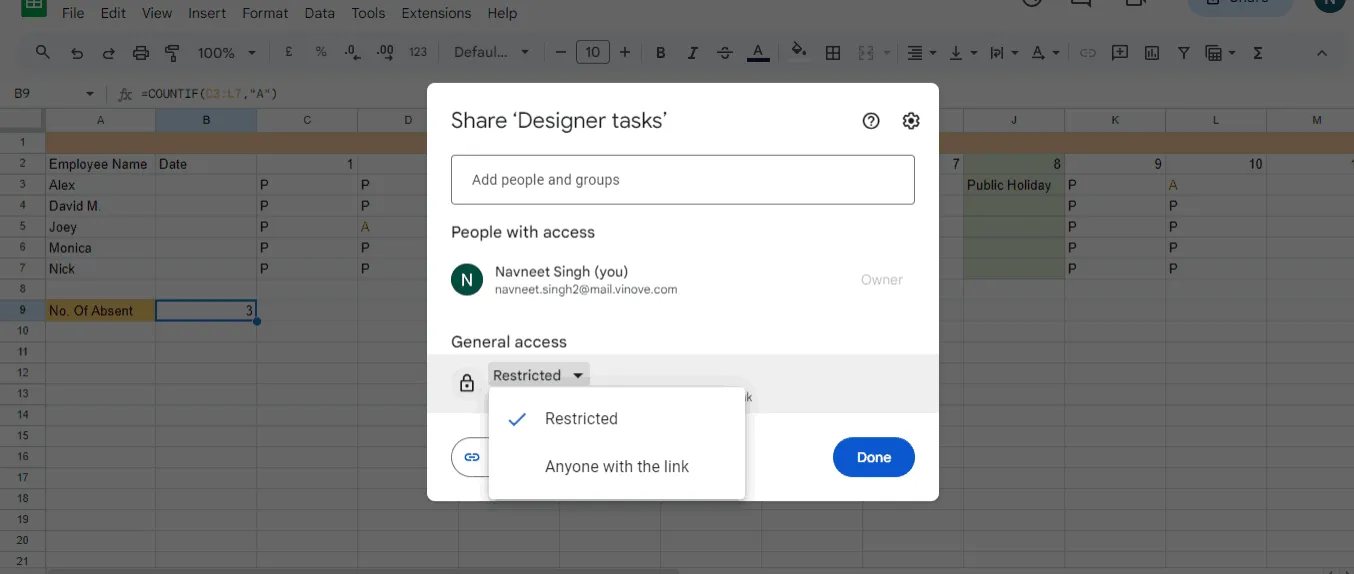
Share the Excel attendance tracker with your employees, allowing them the necessary editing access:
- Save the file in a location accessible to all relevant parties.
- Share the file or provide access to your employees.
- Instruct them on how to enter their attendance data in the designated cells.
Step 8: Monthly Attendance Summaries
Consider creating a separate sheet in the workbook for monthly summaries. Here, you can use Excel functions like
- SUM
- COUNTIF
- AVERAGE
To calculate the total number of working days, absences, and presents for each employee, providing an overview of their monthly attendance performance.
Step 9: Yearly Attendance Tracking
To create a comprehensive yearly attendance tracker, repeat the same monthly structure.
Create different monthly sheets within the same Excel workbook, ensuring consistent formatting and formulas for each month.
By following these detailed steps, you can create a robust Excel attendance tracker using Microsoft Excel, enabling you to effectively monitor, manage, and analyze attendance data for your organization.
Now, let’s look at the advantages and disadvantages of using attendance tracking excel.
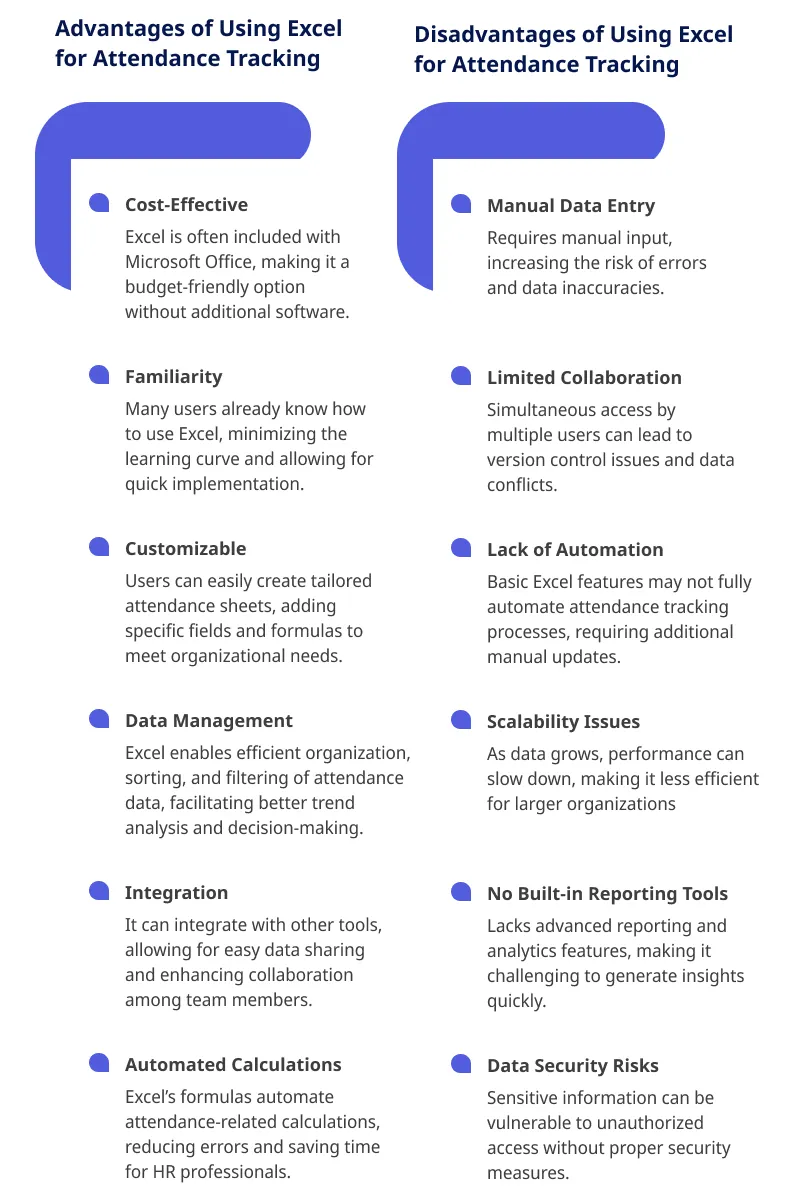
While Excel offers flexibility and affordability, it presents challenges like data entry errors and limited automation.
For those seeking a more comprehensive solution, especially in larger organizations, Workstatus can offer an efficient alternative.
Let’s take a look at how Workstatus can simplify attendance tracking further.
Workstatus: Your Ultimate Employee Attendance Solution
Workstatus is the ultimate employee attendance tracking software solution that offers a comprehensive and efficient way to manage your workforce’s attendance.
Here’s how it simplifies the process:
- Real-Time Attendance Tracking- Instantly see who is working, late, or absent, across office, remote, or field teams.
- Automated Timesheets & Reports- Eliminate manual data entry with auto-generated timesheets and ready-to-use attendance reports.
- Accurate Payroll-Ready Data- Track work hours, overtime, and breaks with precision, reducing payroll errors.
- Remote & Field Workforce Tracking- Monitor distributed teams with features like GPS tracking and mobile clock-ins.
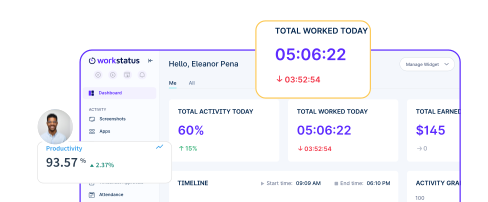
- All-in-One Visibility- Get a clear view of attendance, productivity, and team activity from a single dashboard.
Instead of spending hours managing spreadsheets, teams can automate attendance tracking and focus on improving productivity and delivery.
Workstatus’ Free Tools For Attendance And Workforce Management
Free Time Card Calculator:
Workstatus offers a Free Time Card Calculator, a valuable tool for businesses to calculate employee work hours and attendance data accurately.
This tool simplifies determining the total hours worked, making it an ideal choice for organizations seeking a user-friendly solution for attendance management.
1. Easy Hour Calculation: The Time Card Calculator makes it easy to calculate total work hours based on clock-in and clock-out times. This is essential for precise attendance tracking and accurate payroll processing.
2. Overtime Calculation: The tool can automatically calculate overtime hours, providing a clear breakdown of regular hours and overtime, which is crucial for compliance with labor laws and efficient workforce management.
3. Accurate Time Records: By using this calculator, employers can ensure that attendance records are calculated without errors, leading to greater precision and reliability in tracking employee hours worked.
4. Time and Cost Savings: The Free Time Card Calculator saves time that would be spent manually calculating hours, ultimately improving operational efficiency.
Free Online Timesheets for Employees:
Workstatus provides a range of Free Online Timesheets for Employees to support various attendance tracking needs.
These templates are designed to simplify recording employee work hours and attendance data. For instance, just as students often look for a reliable service to write my essay to save time during hectic exam weeks, busy project managers and freelancers can use these templates to optimize their daily routines. The available timesheets include:
1. Weekly Timesheet: A weekly timesheet template that allows employees to record their daily hours worked and submit it for approval. It provides a clear overview of the entire workweek.
2. Monthly Timesheet: The monthly timesheet template offers a comprehensive view of an employee’s attendance and work hours for an entire month. It’s beneficial for salaried or monthly-paid employees.
3. Bi-weekly Timesheet: This template is designed for employees with bi-weekly pay periods. It facilitates the recording of hours worked for two weeks at a time.
4. Daily Hourly Timesheet: Ideal for tracking attendance in excel daily, this template allows employees to record their clock-in and clock-out times for each working day.
5. Project Timesheet Template: Businesses involved in project-based work can use this template to monitor attendance and work hours associated with specific projects. It simplifies project budget management and tracking of billable hours.
Workstatus’s free tools provide businesses with accessible and convenient solutions for monitoring employee attendance, calculating work hours, and ensuring compliance with labor regulations.
These tools help save time and reduce errors in attendance management processes.
Wrapping Up
Mastering Excel for attendance tracking offers a flexible and cost-effective solution, empowering you to maintain accurate employee attendance records.
However, it’s essential to recognize its limitations, particularly in larger organizations where automation and real-time updates become imperative.
For a more advanced and streamlined attendance tracking experience, consider opting for Workstatus. Its robust features, automation, and scalability make it the ideal choice for organizations looking to elevate their workforce management.