
Table of Contents
Managing today’s workforce isn’t just about tracking work; it’s about maintaining visibility across different ways of working.
Some employees split time between home and the office, while others work fully remotely.
Many others spend their day in the field. It means employees nowadays are working in different models.
However, many organizations use the same tracking approach for all employees.
That’s where problems begin.
An employee performance tracking strategy that works for a hybrid team may not provide accurate visibility for field operations.
Similarly, a process designed for remote work may fail to capture the realities of location-based roles.
Whether you’re implementing remote or field employee tracking, your goal should be to gain clear visibility into work, productivity, and progress.
Why One Tracking Strategy Doesn’t Work for Every Team
The reality is that work happens differently in every environment.
A remote software team, a hybrid operations department, and a field service workforce all require different ways to track work, measure productivity, and maintain visibility.
According to Microsoft’s work trend index, 85% of managers say they struggle to know whether employees are getting enough work done, despite employees reporting high productivity.
What creates meaningful visibility in one workforce model may leave critical blind spots in another.
That’s why effective employee tracking isn’t about using more monitoring tools; it’s about aligning tracking methods with how each team actually works.
How Do You Know Your Tracking Strategy No Longer Fits?
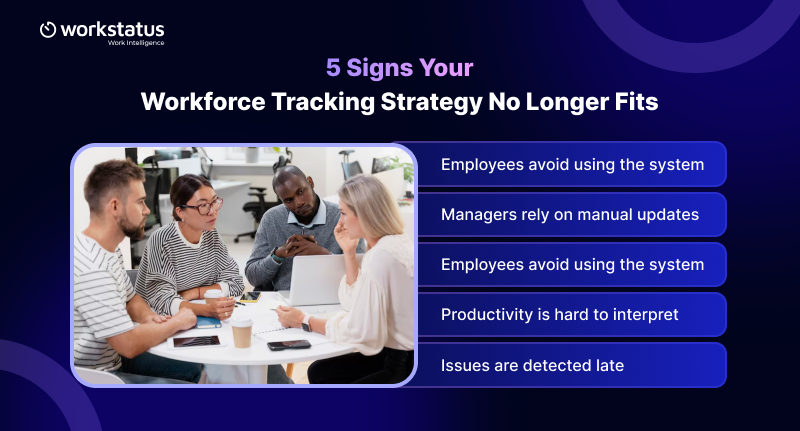
Many service businesses continue using systems built for outdated work models.
Here are clear indicators of misalignment:
1. Employees avoid using the system: Low adoption signals poor workflow alignment.
2. Managers rely heavily on manual updates: Visibility is not coming from the system itself.
3. Reporting differs across teams: There is no consistent measurement framework.
4. Productivity is hard to interpret: Workload and performance insights remain unclear.
5. Issues are detected late: Problems surface only after they impact delivery.
If these patterns exist, the tracking system is no longer aligned with how work happens. The use of a reliable productivity monitoring software can help overcome such issues.
Challenges with Traditional Tracking Strategies
Hybrid, remote, and field teams work differently. Yet many organizations use the same tracking method for every employee, regardless of where or how they work.
Here are some challenges with conventional tracking strategies
1. Limited Visibility Across Different Work Environments
Employees work in different locations and under different conditions.
A single tracking approach often fails to provide the visibility needed for all three environments.
As a result, managers struggle to understand how work is progressing across the workforce.
This is one reason many organizations adopt workforce analytics software to bring workforce data together and turn it into actionable insights.
2. Lack of Proof of Work for Remote and Field Teams
Traditional attendance tracking shows when employees are present, but not always what work was completed.
This becomes a bigger challenge for remote and field teams where managers cannot directly observe daily activities.
Without clear proof of work, it becomes difficult to verify progress, measure productivity, and maintain accountability.
3. Too Many Tools for Different Teams
Organizations often add separate tools to solve different tracking needs.
One tool for attendance. Another for projects. A different solution for GPS tracking or workforce monitoring.
Over time, data becomes spread across multiple systems.
Managers spend more time gathering information and less time managing teams.
4. Inconsistent Performance Measurement
Different roles require different ways of measuring work.
A field technician’s day looks very different from a software developer’s. A customer support representative works differently from a project manager.
When everyone is measured using the same criteria, reports can become misleading.
Some employees appear highly productive, while others may be delivering results that are not fully reflected in the data.
What Remote Employee Tracking Should Focus On
Remote work removes physical visibility, but not accountability. The challenge is to shift focus from observation to insight.
Effective remote employee monitoring software focuses on:
- Work patterns and activity trends
- Output and progress metrics
- Capacity and workload balance
- Project-level performance
Not all productive work is visible through activity alone. Time spent in meetings, planning, problem-solving, or analysis is equally important.
That’s why an effective remote tracking strategy focuses on results, not constant monitoring.
What Field Employee Tracking Requires
Field teams operate in completely different conditions. Technicians, delivery teams, inspectors, and service staff work outside traditional office systems.
Effective field workforce management focuses on:
- GPS-based attendance
- GPS employee tracking
- Location verification
- Job-site tracking
- Shift monitoring
For field operations, accuracy in presence and execution matters more than digital activity.
The goal is operational certainty, knowing where work is happening and whether it is completed.
What Hybrid Workforce Tracking Should Focus On
Hybrid work combines flexibility with complexity. Managers need visibility into work regardless of where employees are working.
Effective hybrid workforce tracking focuses on:
- Work hours and availability
- Workload distribution
- Project progress
- Capacity utilization
- Productivity trends
The goal is not to track location but to understand whether work is progressing efficiently.
Successful hybrid workforce management requires visibility into workloads, collaboration, project execution, and team capacity.
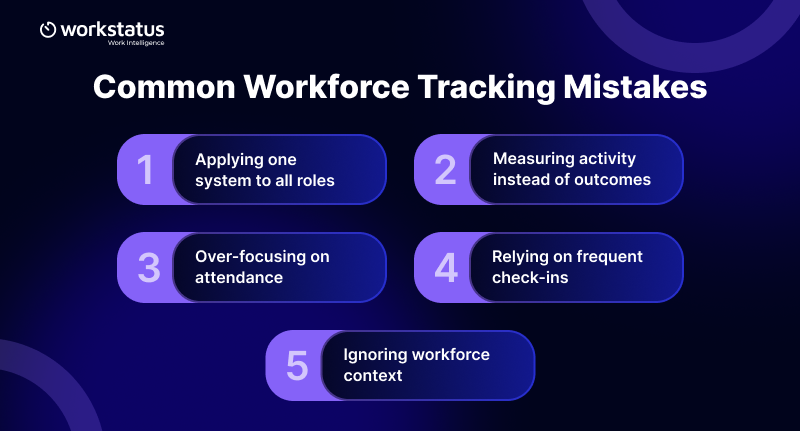
Even with the right tools, many organizations make mistakes that reduce visibility and create reporting challenges.
1. Applying one tracking logic to all roles
Different environments require different tracking logic.
2. Measuring activity instead of outcomes
Hours worked do not always reflect meaningful progress.
3. Over-focusing on attendance
Presence alone does not indicate performance.
4. Relying on frequent check-ins
More meetings do not equal better visibility.
5. Ignoring workforce context
Hybrid, remote, and field teams each require different data signals.
These mistakes reduce clarity and weaken decision-making.
Workstatus- Built for Hybrid, Remote, and Field Teams
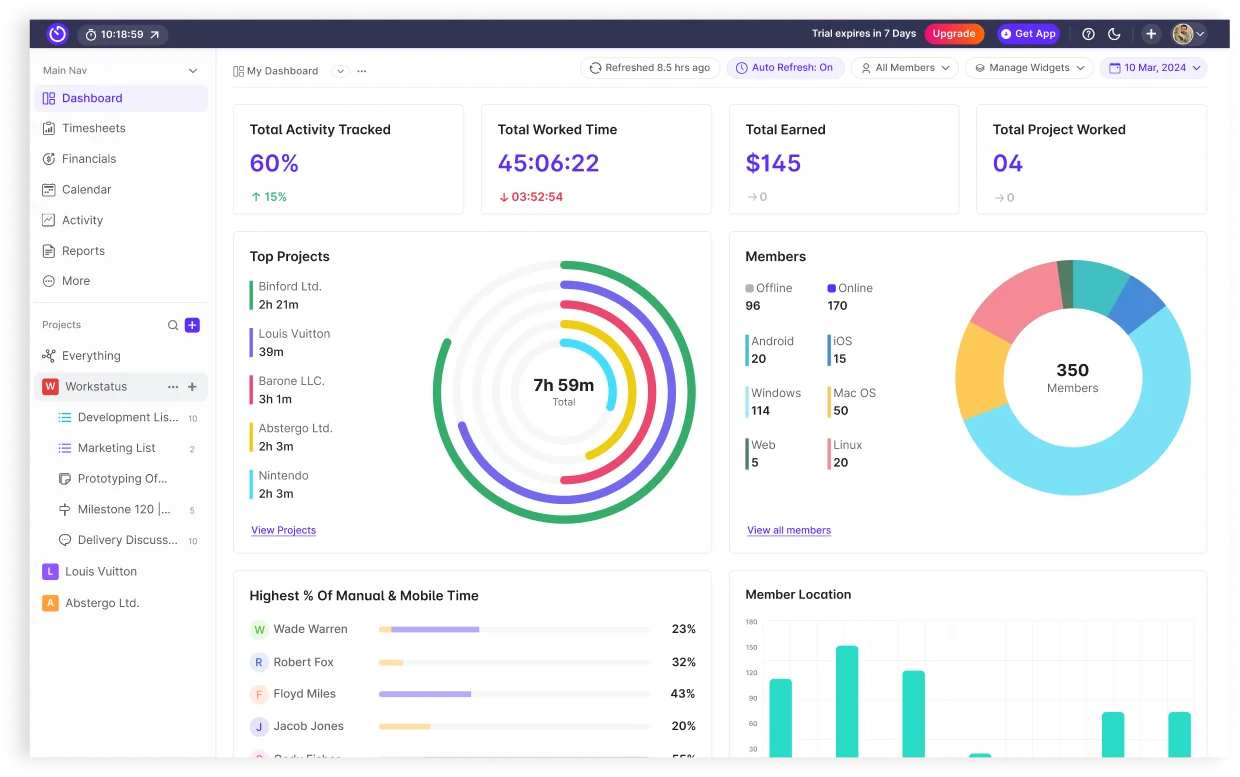
Workstatus combines workforce visibility, productivity insights, and operational intelligence in one platform.
As a Work Intelligence platform, it helps service businesses manage multiple workforce models from a single system.
Remove Productivity Visibility Gaps
Check app and website usage to identify focus & idle hours, improve productivity, and help teams stay focused on high-value work. Gain deeper insights into how work gets done through time tracking software.
Reduce Revenue Leakage
Capture billable hours accurately, prevent missed work logs, and maintain complete proof of work. By using workforce intelligence software, organizations can convert workforce data into meaningful insights.
Prevent Resource Overload and Burnout
Monitor workloads, utilization, and team capacity in real time. Identify workload imbalances early and distribute work more effectively.
Keep Projects Profitable and On Schedule
Check time, productivity, utilization, project progress, and budgets in one place. Gain visibility into project performance before delays or cost overruns occur.
Strengthen Field Workforce Visibility
Verify attendance, evaluate workforce movement, and know job-site activity with GPS-based tracking and location insights.
Simplify Compliance, Audits, and Payroll
Maintain accurate records of attendance, work hours, locations, activity logs, and timesheets to support payroll processing, audits, and compliance requirements.
Final Thoughts
Different work environments have different visibility needs. There is no single work monitoring strategy that fits all.
Many organizations use a single strategy for managing remote, hybrid, and field teams.
This approach leads to reporting gaps, inconsistent insights, and operational inefficiencies.
The goal of effective workforce management is not to simply collect data.
The goal is to create meaningful visibility that helps organizations
- Understand performance
- Improve accountability
- Make better decisions
Whether you are using hybrid, field, or remote employee tracking, the success of your strategy depends on whether or not it aligns with the way work actually happens.
When there is a strong alignment, it helps organizations to gain better workforce visibility, more reliable insights, and better business outcomes.
FAQs
Q. How do I know if my employee tracking strategy fits a hybrid, remote, or field workforce?
Ans. If it provides clear visibility into attendance, productivity, workload, and work progress with minimal manual effort, it’s likely a good fit.
Q. Should hybrid, remote, and field employees use the same tracking strategy?
Ans. No. Different work environments create different visibility needs and require different tracking methods. Applying the same approach across all workforce models often leads to incomplete insights.
Q. What is the best employee tracking method for hybrid teams?
Ans. The best employee tracking method for a hybrid team focuses on
- Productivity
- workload distribution,
- capacity utilization.
Hybrid tracking should help managers track work progress and resource utilization, rather than focusing on employee location.
Q. How is remote employee tracking different from field employee tracking?
Ans. Remote employee tracking focuses on work activity, productivity patterns, project progress, and capacity utilization.
Field employee tracking focuses on attendance verification, workforce movement, location visibility, and task completion.
As the work environments are different, the visibility requirements are different as well.
Q. What features should I look for in employee tracking software?
Ans. The right solution should help improve visibility without increasing administrative work. Key features to look for in employee tracking software include:
- Time tracking
- Attendance tracking
- Productivity insights
- Project visibility
- Reporting and analytics
- GPS tracking for field teams
The ideal platform should provide you with accurate information while remaining easy for employees to use.
Q. Can the wrong tracking strategy impact productivity and engagement?
Ans. Yes. When tracking doesn’t match how employees work, adoption drops, visibility declines, and productivity can suffer.
Q. How do I choose the right tracking strategy for my business?
Ans. Choose a strategy that matches how and where work gets done while providing managers with the visibility needed to make informed decisions.
Q. What are the most common workforce tracking mistakes?
Ans. Common mistakes include:
- Applying the same tracking method to every role
- Measuring activity instead of outcomes
- Focusing only on attendance
- Relying heavily on manual updates
- Ignoring differences between hybrid, remote, and field work environments
Avoiding these mistakes helps organizations build a more effective and sustainable workforce tracking strategy.