
Table of Contents
Your revenue can grow while your margin gets thinner. The reason is usually not price. It is paid time that never turns into paid work. Time leakage in service businesses causes most of that damage.
You see revenue closely. You rarely understand what happens to the hours behind that revenue. You already pay for every hour your team works.
You only get paid for some of them. The gap between those two numbers is where your margin lives.
Billable utilization in plain terms: Out of every hour you pay someone for, how much of it does a client actually pay you back for?
In most service businesses, that answer is lower than anyone expects. Not because people are slow. Because paid hours keep disappearing into work that never reaches an invoice.
Your profit and loss statement records salaries. It does not record what those salaries produced. So service business profitability slips quietly. The leak stays invisible until margin drops, and nobody can explain why.
The real issue is the gap between time spent and value delivered:
- Too much time goes to non-billable work
- Projects take longer than expected
- High-cost resources may be tied up in low-value tasks
- Overtime can build up without improving output
This article walks through seven leaks that cause most of that damage. None of them look serious on their own. Together, they can quietly make your projects less profitable.
Why Time Leakage in Service Businesses Becomes a Margin Problem
Most time leaks in business are easy to ignore because they never arrive as a bill. They arrive on a slightly longer day. Take a simple example.
One person loses 30 minutes a day to avoidable delay. That feels like nothing. Now run it across a team of 40 people over 22 working days. That is 440 hours in a single month. Across a year, it is more than 5,000 hours.
At a billing rate of $30 an hour, you have quietly given away $150,000. You still paid the salaries. You just never sold the output.
This is why time leaks impact service business margins more than most cost problems. A time problem hides inside a headcount you already approved. There is a second effect too.
When capacity leaks, most businesses respond by hiring. So you add a fixed cost on top of a problem you never fixed. Your margin drops twice.
7 Hidden Time Leaks That Quietly Destroy Margins
The seven leaks below follow the same pattern. Each one starts as a small inconvenience. Each one repeats every day.
Each one converts paid hours into unpaid hours. Read them with your own operation in mind. Most businesses will recognize three or four immediately.
1. Untracked Billable Hours
The largest leak in most service businesses. Work happens. Nobody knows it. So nobody bills it. It shows up in familiar places:
- A client call that never reaches a timesheet
- An extra revision handled on the spot
- Troubleshooting after a job is marked complete
- Weekend work reconstructed from memory on Monday
This hits delivery teams hardest. A developer fixes a client issue between two sprint tasks and never logs it. The client gets the fix. Your project record never shows the hour.
Late timesheets are the usual cause. By the time someone fills one in on Friday, half the week is a guess. Reconstructed time is always underreported.
People round down when they are unsure, and that is where billable time leakage starts. Missing hours also distort your next quote.
If a project really took 340 hours but your records show 280, you will price the next one too cheaply. Lost billable hours are rarely a discipline problem. They are a recording problem.
Asking people to remember better does not fix this. Capturing time while the work happens does. This is the gap that time tracking software is built to close, though not all of it works the same way.
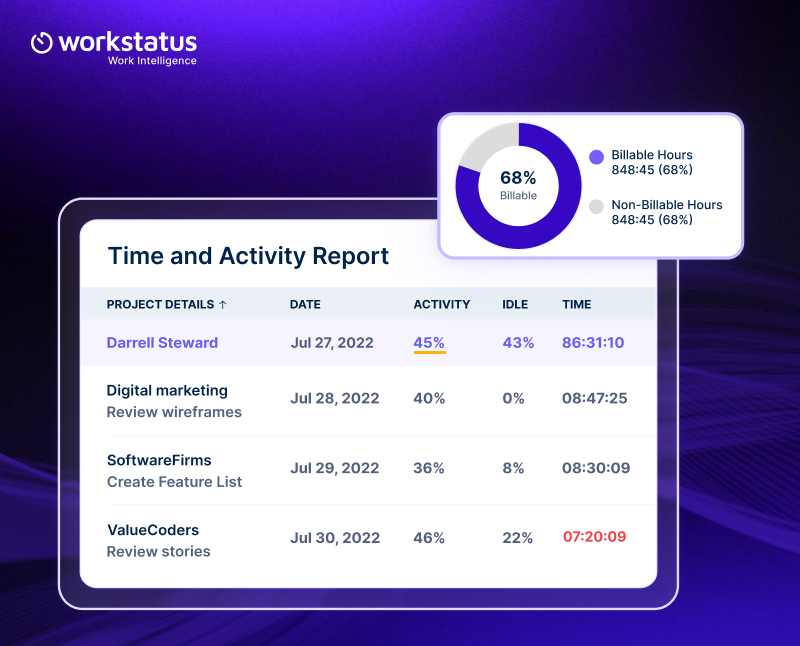
Workstatus is a work intelligence platform, which simply means it turns the hours your team works into a record you can act on. It captures hours as work happens and connects them to projects, so missed hours are easier to spot.
- See which hours a client pays for and which ones you absorb
- Bill from a record of the work instead of someone’s memory
- Catch hours that never reached an invoice
- Show proof when a client questions a line on the bill
- Compare hours logged on a project with the hours you quoted
This makes billing more accurate and project costs clearer.
2. Excessive Administrative Work
Administrative work is necessary. The volume of it usually is not. Somewhere in your business, skilled people are spending large parts of the day on coordination rather than on the work you hired them for.
As per McKinsey Global Institute research from its 2012 social economy study, the average interaction worker spends about 28% of the week on email and close to 20% more looking for information. That is almost half the week gone before anyone starts the work you sell.
Inside a service business, it usually looks like this:
- Filling the same job details into two or three systems
- Rebuilding weekly status reports by hand
- Updating job records after the fact instead of during the work
- Chasing colleagues for information that already exists somewhere
Every hour spent here is an hour of skilled capacity you paid for and cannot sell. You are paying an engineer rate for data entry output. The test is simple. If a task produces no client value and no decision, it is overhead, not work.
3. Waiting for Information, Approvals, or Decisions
Waiting is the quietest leak of all. Nobody logs it. Everybody experiences it. Your team waits for scope confirmation. They wait for a client to reply. They wait for pricing before they can quote.
They wait for a decision that only one person can make. Two things make waiting expensive. First, it usually happens mid-task. So the work stops before it produces anything billable. Second, it repeats.
A two-day approval delay on one job is annoying. The same delay across 60 jobs a month becomes a structural limit on how much work you can deliver.
On a fixed-price project or a retainer, waiting costs you twice. The budget keeps burning while the work stands still. So you deliver the same job and earn less.
Approval bottlenecks are worth checking first. If one person has to approve everything, their calendar caps your delivery speed.
Workstatus collects pending time and exceptions into one approval queue. A manager clears them in a few minutes instead of chasing people across email and chat.
4. Inefficient Travel and Scheduling
For any team that works across sites, the schedule decides the margin. The same eight-hour day produces very different results depending on how the jobs are ordered. Common causes of loss:
- Jobs booked by availability rather than by location
- Long gaps between appointments that are too short to fill
- Last-minute changes that break an efficient route
- Two people sent across town when one nearby person could have handled it
Here is the arithmetic. Someone doing four jobs a day with 45 minutes of travel between each one spends three hours on the road. Cut that to 25 minutes, and you free up more than an hour.
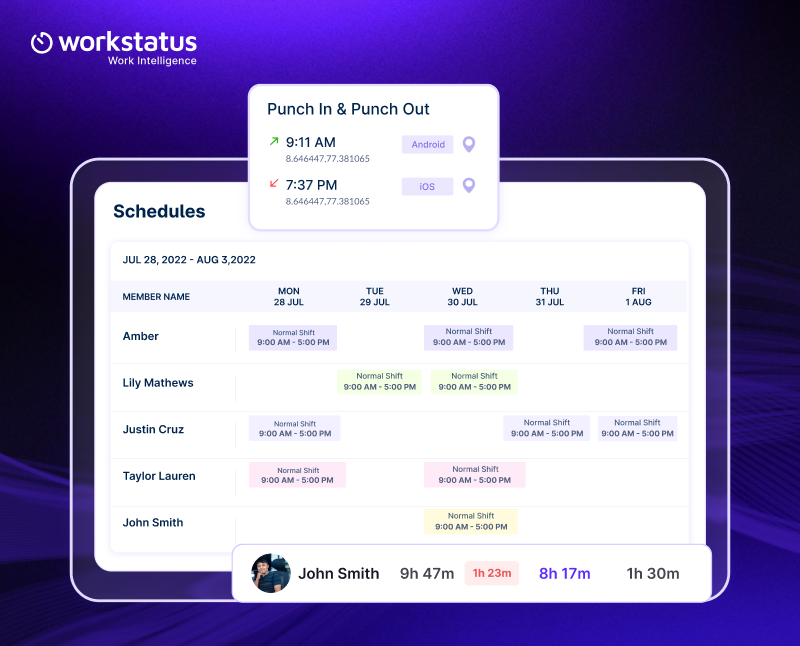
That is often a fifth job. You cannot fix a schedule you cannot see. Workstatus records where the hours go across job sites, so you can tell which days lose time to travel and which schedules need a rethink.
- See how much of each day goes to travel and how much goes to the job
- Confirm attendance at the right site
- Compare planned shifts with the hours people actually worked
- Give a manager one clean record to approve at the end of the week
Workstatus does not plan your route. It shows you where the hours went, so you can see which schedules cost you a job. One extra job a day per person lifts revenue per head without adding a salary.
5. Meetings, Interruptions, and Context Switching
This leak is the hardest to see because it spreads across the whole day in small pieces. The broader workplace data shows just how frequent these interruptions can be.
Microsoft’s 2025 Work Trend Index found that employees are interrupted by a meeting, email, or chat every two minutes during core work hours.
A ping arrives. A question interrupts. A task gets parked halfway through so something urgent can jump the queue. Each interruption costs more than the interruption itself.
This is the least visible form of employee time leakage, because no single moment looks wasteful. Getting back into complex work takes time. Do that often enough and a full day produces half a day of output.
For anyone managing delivery, the pattern is usually worse. Their day is filled with the same operational questions repeated by different people. Where is that job? Who approved this? What did we quote?
In a BPO or KPO operation, the questions change but the cost stays the same. Who is late on this shift? Which client account did those hours go to? Why do the paid hours not match the roster?
Those questions are a symptom. They mean the answer is not visible anywhere, so people have to ask a human for it.
Workstatus cuts down the need to ask. Job status, hours logged, and approvals all sit in one place for people to check themselves, with fewer interruptions for your team.
6. Poor Job Preparation
Most rework is decided before anyone starts working. It is decided at dispatch. Someone arrives without the right information. Someone arrives without the right part.
Someone arrives to find the scope on paper does not match the scope on site. Unclear expectations at the start always create wasted hours at the end.
The scale of the problem is significant: 48% of home service businesses identify jobsite management as one of their biggest daily time drains, according to Jobber’s 2026 Home Service Trends Report.
Weak preparation usually traces back to one of these:
- Work orders that are incomplete or copied from an old job
- Customer details nobody verified
- Parts or access requirements confirmed too late
- Scope agreed on a call that nobody wrote down
The fix is almost always cheaper than the failure. Ten minutes of checking before dispatch can save a four-hour return trip.
7. Rework and Repeat Visits
Rework costs you the most because you do the same work twice and get paid once. It usually starts in one of four places:
- Someone read the problem wrong the first time
- Someone finished the job but never closed it out properly
- Two people understood the same request differently
- Nobody wrote anything down, so the next person started over
Project work does the same thing under a different name. It is called scope creep. The work keeps growing inside a fixed fee until you are doing things nobody agreed to pay for.
The hours are real. The invoice stays the same. Rework has a second cost too. Every repeat visit takes a slot that a new job could have filled.
Before you quote the next fixed-price project, run the last one through a project margin calculator. You will see what the extra rounds of work actually cost you.
How to Measure Time Leakage in Service Businesses
You do not need a productivity program. You need one month of honest data. As per SPI Research’s 2026 Professional Services Maturity Benchmark, billable utilization across services firms fell to 66.4% in 2025.
That is the lowest level SPI has ever recorded and sits well under the 75% mark it treats as healthy. Start here:
- Track where hours actually go rather than where you assume they go
- Sort every hour into three groups
- List the delays that repeat every week
- Estimate the hours lost to each one
- Rank them by cost and fix the top one
The three groups are simple. Hours you can bill. Hours you cannot bill but genuinely need. Hours nobody needed at all. Use this to size each leak:
Frequency × Time Lost × Number of Employees = Total Time Leakage
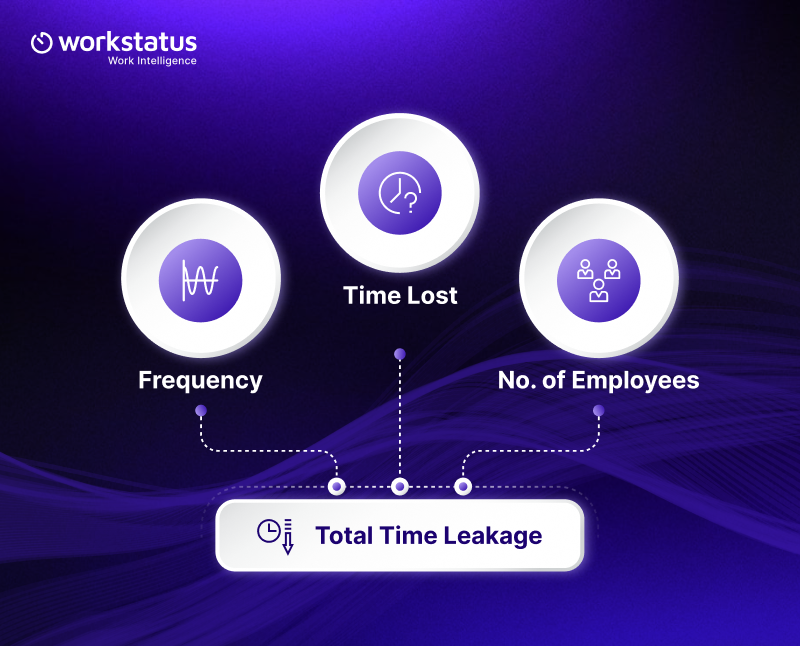
If you would rather not build the sheet yourself, a billable hours leakage calculator will do the same work for you. Here is a worked example. Approval delays hit 12 times a month. Each one costs 40 minutes. Eight people are affected.
12 × 0.67 hours × 8 = about 64 hours a month. At a $30 rate, that single leak is worth roughly $1,900 a month, or $23,000 a year.
Do that calculation for all seven. The ranking will surprise you. The leak that annoys you most is rarely the leak that costs you most.
Workstatus follows a simple sequence. Capture the time as it happens. Attribute it to the right client or job. Verify it against the work. Resolve the gaps while people still remember them.
Let a manager approve it. Then turn that approved record into an invoice or a report you can defend.
Because the record is created during the work rather than reconstructed afterwards, you can see things you could not see before:
- Utilization for each person and each client
- Hours logged against a job compared with hours quoted
- Where time sits idle between tasks
- Which jobs consistently run over
- Which hours are billable and which quietly are not
Would you be comfortable showing a client a line-by-line record of the hours you billed them? If the answer makes you pause, that is your starting point.
Conclusion
Your biggest margin problem may not be an expense at all. Expenses are visible. You approve them, record them, and review them every month.
Lost hours get none of that attention, yet they raise your real cost per delivered hour and shrink the capacity you have to sell.
If you cannot line up people, hours, and projects before month-end, you are not looking at a reporting problem. You are looking at a margin problem.
So before you hire another person or push your team harder, check what you already own. Time leakage in service businesses hides capacity, not cost.
Most firms are sitting on a month or more of recoverable capacity they have already paid for. The fastest way to improve profit margins in service business operations is to recover capacity you already have.
You do not have to recruit it. You do not have to train it. You only have to find it. Pick one leak this week. Measure it for 30 days. Then decide what it is really costing you.
FAQs
1. What is time leakage in a service business?
Ans. Time leakage is paid time that never converts into billable work or useful output. It shows up as lower utilization and thinner margins rather than as a visible cost on your books.
2. Why don’t time leaks appear in financial reports?
Ans. Your accounts record what you paid your team, not what those hours produced. So the loss sits inside an approved salary line and stays invisible until margin drops.
3. Which time leak costs service businesses the most?
Ans. Untracked billable hours usually cost the most, because the loss happens twice. You miss the revenue on the current job and then underprice the next one using the same incomplete records.
4. How do I measure how much time my business is losing?
Ans. Use frequency multiplied by time lost multiplied by number of people affected. Run that calculation for each recurring delay, then rank the results by cost rather than by how much they frustrate you.
5. Will fixing time leaks actually improve margin?
Ans. Recovered hours become sellable capacity without adding salary, so your cost per delivered hour falls. Most service businesses find a month or more of capacity they have already paid for.