
Table of Contents
Your delivery team is executing projects on time. Utilization looks strong across the board. Your team worked the hours and billed the clients. But when you close the month and reconcile billing against time records, something doesn’t add up.
The hours your team worked don’t match what you charged. The projects that look profitable on paper aren’t. And the margin you expected has quietly disappeared.
This is time leakage – when billable hours seep through process gaps before they can be captured, attributed, and billed.
The gaps are so gradual you don’t notice them until they compound. Approval happens days late. Hours exist in one system but never reach the billing system. Each gap is small, but together, they cost you significant revenue.
While eliminating every drop of time leakage is difficult, closing these process gaps can dramatically reduce your losses and recover the revenue your team earned.
What Is Time Leakage?
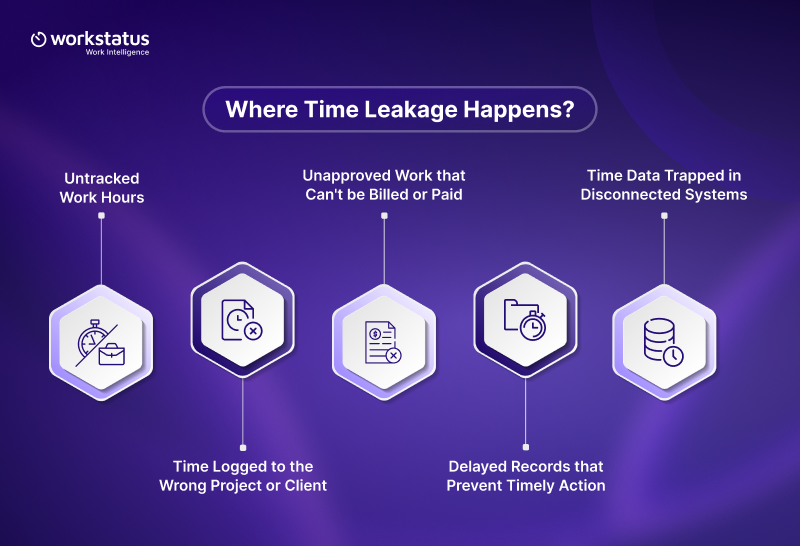
Time leakage happens when billable hours disappear into gaps between work and the records that prove it.
Time leakage includes the following:
- Hours that aren’t recorded at all.
- Time recorded but not attributed to the right project or client.
- Work that happens but isn’t approved, so it can’t be billed.
- Records are too late to act on, so managers can’t course-correct before month-end.
- Time that exists in one system but isn’t connected to the system that needs it.
The result: You have less billable time to charge clients, lower project margins, and no clear picture of where work actually happened.
Common Examples of Time Leakage
These aren’t lazy employees. These are broken workflow gaps where time exists, but visibility doesn’t.
- A developer finishes a task at 5 pm but doesn’t log it until Friday. By then, some hours are forgotten. Eight hours become six. The hours disappear silently. Real-time employee time tracking captures work as it happens, preventing these lost hours.
- A shift worker finishes a task, but approval comes three days later. By then, the week is over. The work sits unverified. This is a common revenue leakage example where hours slip away due to delayed approvals.
- An operations manager runs a client strategy meeting. Three hours of team time. It’s not logged as billable because “it wasn’t active project work.” These internal hours stack up to 30-40% of actual work, week after week.
- An agency manager spends Friday coordinating requests but has no record of the work. The work happened. The record didn’t.
These are just a few revenue leakage examples. There are many more ways time leakage and revenue leakage happen in your organization.
How Time Leakage Impacts Your Business
According to Gallup (2026), only 31% of employees are engaged at work. That disengagement shows up as lost productivity. But the real damage is what you can’t see.
For service businesses, every hour has value. If time isn’t tracked, connected to the right work, or reviewed in time, revenue starts slipping away.
Time leakage costs a business roughly $20,000 annually per person when just two unbilled hours slip away each week. Here’s what this adds up to:
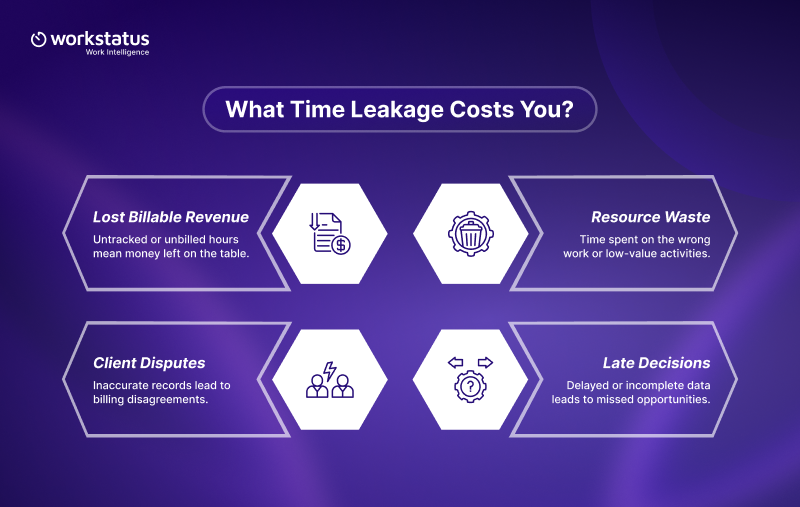
Lost billable revenue. If your team loses 20% of billable hours and your average rate is $120 per hour, a 20-person team costs you roughly $1.2M per year in unbilled work. Billable hours tracking helps recover this lost revenue.
Margin erosion. Fixed-price projects have a margin cap. When scope creep goes unseen because time isn’t tracked, hours grow. Your margin shrinks. That’s real profit that disappears.
Resource waste. You staff based on what you think your capacity is. Without visibility into where time actually goes, you either overstaff and lose money or understaff and miss deadlines. Both hurt profit. Resource management software provides the visibility needed to prevent this waste.
Client disputes. When you can’t prove the hours you’re billing, clients push back. You eat the cost or spend time defending invoices. Either way, you lose.
Late decisions. By the time you know a project is in trouble, three weeks have passed. Fixing it then costs more than catching it early.
How to Identify Time Leakage in Your Business
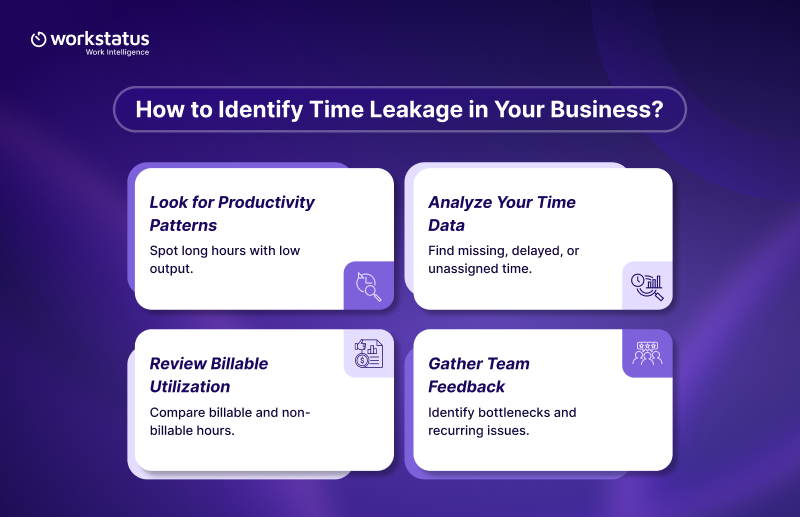
Look for Productivity Patterns
Businesses experiencing time leakage often notice recurring operational problems:
- Missed deadlines
- Budget overruns
- Delayed project delivery
- Uneven team workloads
These patterns indicate underlying inefficiencies that need closer analysis. Revenue leakage detection starts with recognizing these operational red flags.
Analyze Your Time Data
Compare estimated project hours against actual time spent. Look for recurring discrepancies. Review trends across departments or projects to find where bottlenecks happen.
If administrative work consistently takes longer than expected, automation may help reduce unnecessary labor. Time tracking software provides the data foundation for this analysis.
Review Billable Utilization
Billable utilization measures how much team time directly contributes to revenue-generating work. Low utilization rates may indicate excessive administrative work, inefficient processes, or poor workload distribution. Monitoring utilization helps identify opportunities to improve productivity and profitability.
Gather Team Feedback
Your team knows where time is wasted. Regular feedback sessions reveal workflow frustrations, communication issues, and repetitive tasks that you might not notice. Open communication allows teams to share ideas for improving efficiency.
How to Prevent Time Leakage
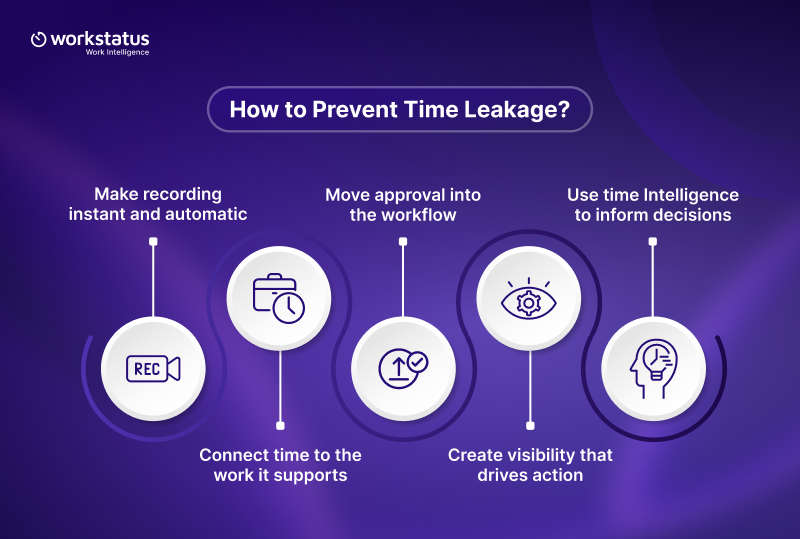
Stopping time leakage requires action on five fronts:
1. Make Recording Instant and Automatic
Capture time when the work happens, not after. When a developer starts a task, record it. When a shift worker clocks in, their assignment is clear. When a field technician arrives at a job, location and time log automatically.
Real-time employee time tracking improves accuracy. One developer might forget what happened between 2 and 3 pm by Friday, but logging at 3 pm means zero guessing. Automated reminders reduce forgotten entries. Eliminate the loss of time by implementing automatic recording systems instead of manual timesheet reminders.
2. Connect Time to the Work It Supports
Hours should flow directly from the work record to billing, payroll, and project systems. A developer’s time automatically connects to their project. A shift worker’s clock connects to their account and shift. A field technician’s location connects to their assigned job.
Automation matters. Manual attribution is where accuracy dies. Billable hours tracking systems automatically connect work to revenue, eliminating gaps.
3. Move Approval Into the Workflow
Approval shouldn’t wait until Friday. Managers should review and approve records as work happens or by the end of the day. Real-time approval makes exceptions visible before they compound.
Set clear priorities so managers can focus on what matters. A developer switching between 5 projects loses 15-20% of productive time to context switching. Establish clear priorities, minimize distractions, and ensure meetings serve a specific purpose.
4. Create Visibility That Drives Action
Bring all work data into one view so managers can quickly see billable hours, project risks, staffing gaps, idle time, and pending approvals.
Historical data helps improve future planning, while real-time visibility makes it easier to balance workloads and act before issues impact delivery.
A time intelligence platform provides the visibility managers need to prevent revenue leakage.
When you can view workloads, project timelines, and resource availability in real time, you distribute work more effectively and reduce bottlenecks. If a project estimated 40 hours but consistently takes 60; your next estimate should reflect that. A manager can see “this team is overloaded; that team has capacity” and act immediately instead of discovering it at month-end.
5. Use Time Intelligence to Inform Decisions
A time intelligence platform uses patterns in your time data to answer real business questions automatically:
- Which clients or projects are actually profitable?
- Where is your team spending effort?
- What’s your real billable utilization?
- Which projects historically overrun?
- What’s your true project margin?
These insights help you staff better, price smarter, and manage scope. A single manager spending 5 hours per week on timesheet reminders and manual approvals costs you $250-500 per week in lost time. Multiply that across a 10-person finance team, and time intelligence pays for itself in weeks. Productivity management software with built-in revenue leakage prevention capabilities reduces this overhead automatically.
How Workstatus Helps Prevent Time Leakage
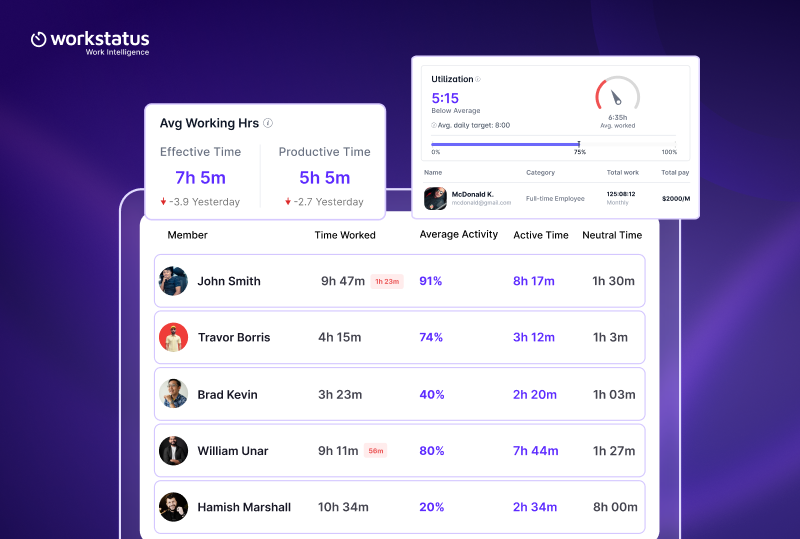
The key to stopping time leakage is solving all five problems at once: capturing time accurately, connecting it to the right work, getting real-time approval, creating visibility, and turning data into decisions.
Workstatus helps prevent time leakage and revenue leakage through four intelligence pillars.
Work Intelligence – You see exactly where your team is spending effort and not where you think it is. Every hour flows from capture to the project that owns it. No guessing. No gaps.
Utilization Intelligence – You know what percentage of time is billable, what’s overhead, and where efficiency leaks happen. You see which clients and projects are actually profitable.
Margin Intelligence – Fixed-price projects stop becoming surprises. You catch scope creep in real time. You understand your true project margin before the project ends.
Capacity Intelligence – You hire staff based on data, not hope. You see real capacity before overcommitting. You prevent teams from becoming overloaded. You make decisions that stick.
The result: billable hours recover. Margins improve. You know exactly what to bill. Your team works the same way, but now you can see it, measure it, and act on it.
The Path Forward
The question isn’t whether you have time leakage. The question is how much it’s costing you and how quickly you can prevent it. Every untracked hour is a missed opportunity to improve profitability. By connecting time, projects, approvals, and billing, you turn hidden losses into actionable insights and stronger margins.
FAQ
1. What is time leakage in business?
Ans. Time leakage happens when billable hours don’t get recorded, get recorded incorrectly, or get approved too late to use. Small gaps across your team, a forgotten hour here, a delayed approval can add up to thousands in loss of time and lost revenue annually. Understanding what time leakage in business is essential for any service organization.
2. What is revenue leakage?
Ans. Revenue leakage is when your business loses money because time isn’t tracked or billed properly. A developer’s time doesn’t connect to the client, approval comes days late, or work completes with no proof. Each gap costs unbilled work or lower margins.
3. How does time leakage impact business revenue?
Ans. Time leakage cuts revenue three ways: billable hours disappear and don’t get charged, fixed-price projects lose margin when scope creep goes undetected, and staffing decisions become guesses. Understanding how time leakage impacts business revenue is critical for preventing profit loss.
4. How do I identify revenue leakage in my business?
Ans. Revenue leakage detection begins by looking for patterns: missed deadlines, overtime, and budget overruns. Analyze time data and compare estimates versus actual hours. Review billable utilization rates and ask your team where workflow breaks. If they’re rounding down, logging late, or not recording internal work, you have leakage. Conducting a revenue leakage audit with time tracking software helps identify the full scope of the problem.
5. How do I prevent revenue leakage?
Ans. Revenue leakage prevention requires capturing time when work happens. Automate repetitive tasks (reminders, approvals, payroll). Improve project planning with historical data. Increase visibility so you can act before problems compound. Create accountability so accurate time tracking becomes habit. Using time intelligence platforms and billable hours tracking systems significantly reduces loss of time and revenue leakage.
6. How does time tracking software help prevent time leakage?
Ans. Time tracking software captures hours accurately and creates visibility. When combined with automation, real-time approvals, and system integration, it stops time leakage at every point where hours disappear.