
Table of Contents
You track hours all day, but still lack real-time visibility into how that time affects
- Productivity
- Billable & Non-billable utilization
- Project outcomes
Without Time Intelligence, important work patterns stay hidden, making it difficult to make informed decisions.
And you most often face:
- Low team utilization
- Missed billable hours
- Uneven workloads
- Lower project margins
- Capacity forecasting issues
Read this blog to learn what Time Intelligence is, why it matters, and how it helps you make smarter decisions using time data.
Understanding Time Intelligence?
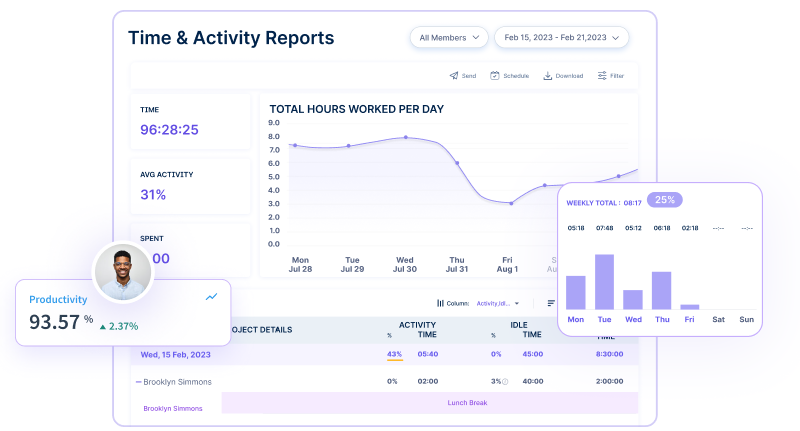
Time intelligence means knowing how time is spent at work and what that time means for productivity, efficiency, and business performance.
Here’s how it helps:
- Goes beyond basic time tracking
- Measures productivity and billable hour efficiency
- Simplifies accurate billing and invoicing
- Provides proof of work visibility
Thus, you can use time data strategically to improve workflows, performance, and profitability.
Why Time Tracking Alone Isn’t Enough
Time tracking shows how many hours people work.
However, it does not explain how those hours affect productivity, utilization, project delivery, or business performance.
Without the real-time insights, it becomes difficult to spot problems early and make informed decisions.
Let’s look at some common challenges:
- Teams work hard, but profits stay low
- Projects take longer than expected
- Billable hours are hard to track
- Employee burnout is often missed
- Managers spend too much time on reports
- Planning team capacity becomes difficult
These challenges are common in service businesses where time directly affects revenue and profitability.
Moving from Time Tracking to Time Intelligence
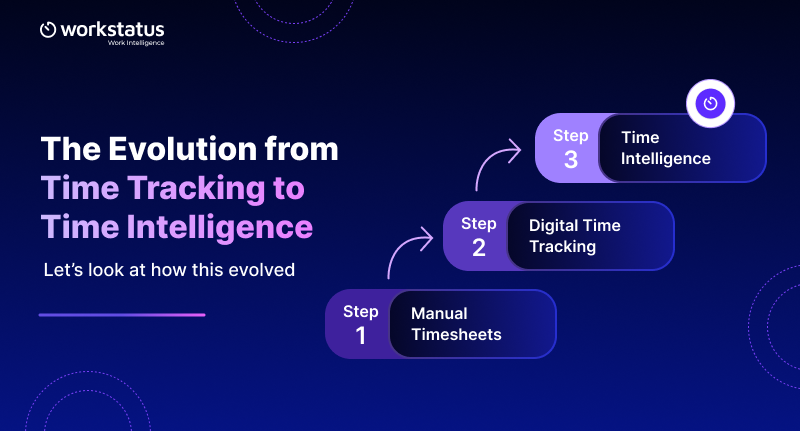
Time tracking has evolved beyond simply recording work hours.
As time tracking became automated, you gained the ability to see
- Productivity
- Work patterns
- Project performance
- Team utilization
Today, you need more than timesheets, they need insights that help them make better decisions.
Time Intelligence helps businesses:
- Track productivity trends
- Understand work patterns
- Improve team utilization
- Identify time leakage
- Plan resources effectively
With this, you can move from tracking work to understanding how work impacts performance.
Key Components of Time Intelligence
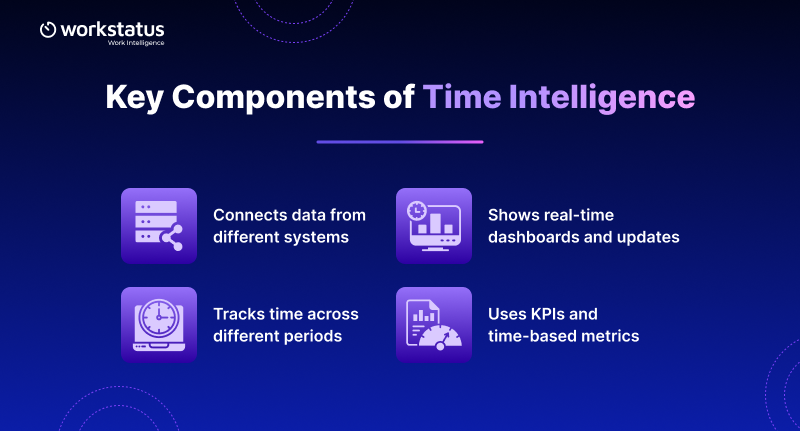
A time intelligence framework helps you understand how time is being used across teams and projects.
It brings all work data together and helps managers track productivity, performance, and workloads more clearly.
Here are the main parts of a time intelligence framework:
Connects data from different systems
- Brings together data from projects, tasks, payroll, and time tracking.
Tracks time across different periods
- Helps you review work daily, weekly, monthly, or quarterly.
Shows real-time dashboards and updates
- Gives managers live visibility into work progress and team activity.
Uses KPIs and time-based metrics
- Check important numbers like billable hours, productivity, and team utilization.
These components help you improve planning, increase efficiency, and maximizing productivity.
Workstatus: Smarter Workforce Decisions with Time Intelligence
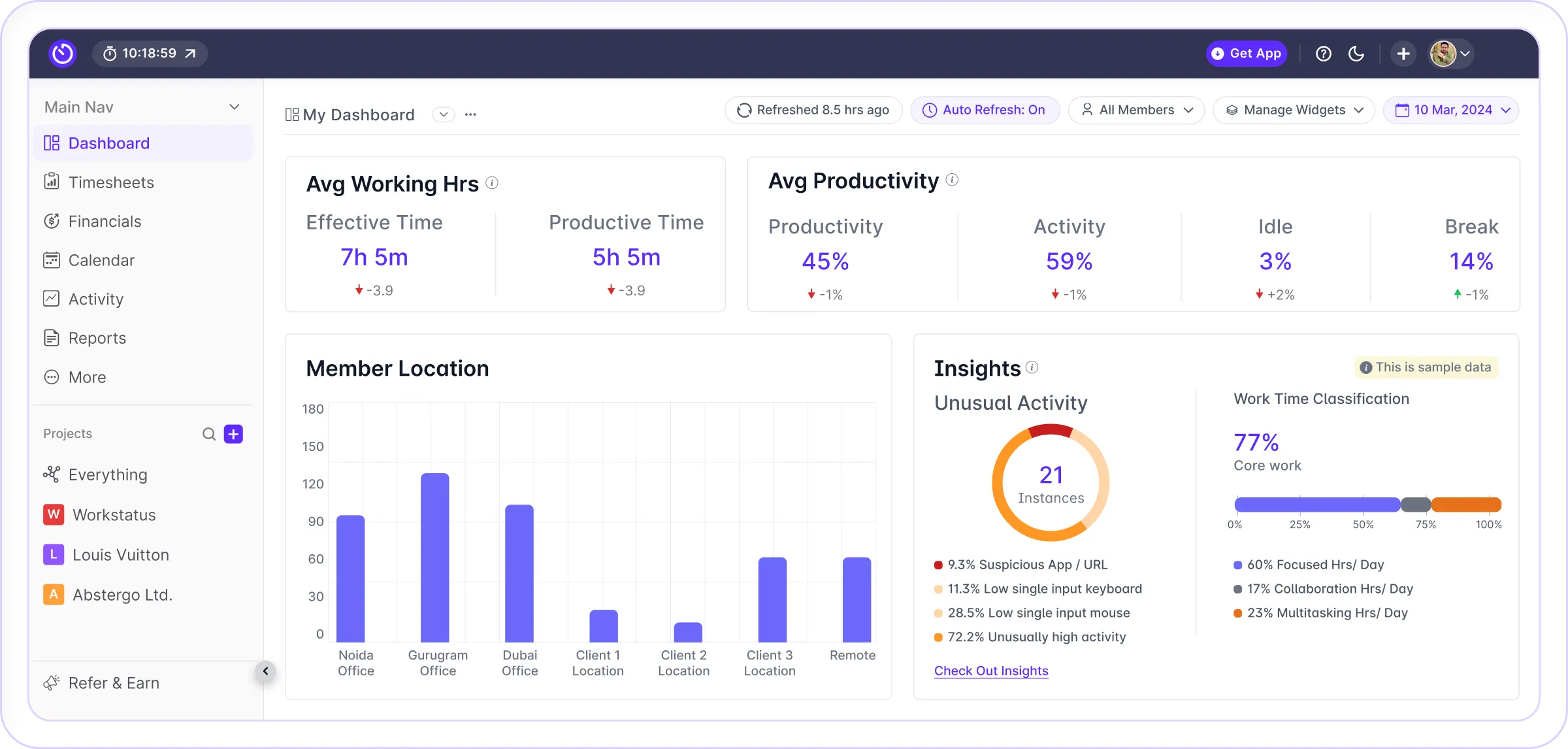
With Workstatus , you can understand how time impacts business outcomes.
Get the visibility you need to make faster and smarter workforce decisions.
Here’s how:
1. Billable vs Non-Billable Split
Know exactly where your team’s time goes.
- Find missed revenue opportunities
- Reduce time leakage
- Improve project margins
This helps you maximize revenue from every hour worked.
2. Auto-Approved Timesheets
Remove delays caused by manual approvals.
- Save approval time
- Reduce manual work
- Keep records accurate
Your team can focus more on work and less on admin work.
3. Client Billing & Invoicing
Turn tracked time into accurate client invoices.
- Create invoices faster
- Reduce billing errors
- Track billable work easily
- Improve cash flow
This makes billing simpler for both your team and your clients.
4. Utilization Patterns Across Projects
See how teams spend time across projects.
- Balance workload distribution
- Identify available capacity
- Allocate resources better
You can assign work more effectively and avoid resource gaps.
Industry Use Cases of Time Intelligence
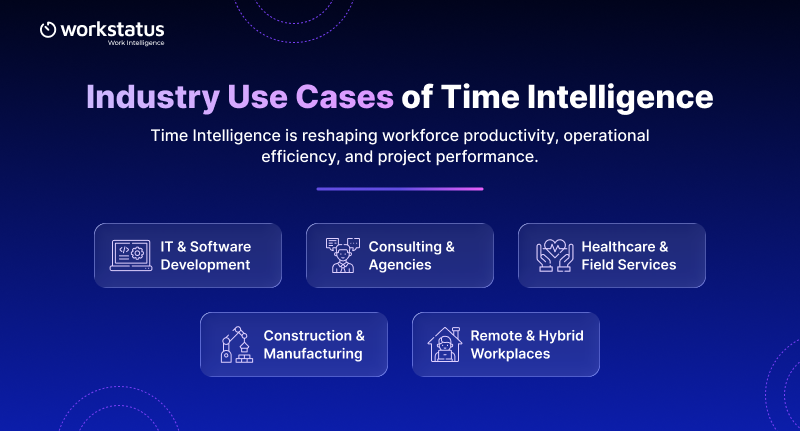
Time Intelligence is transforming how you manage workforce productivity, operational efficiency, and project performance across industries.
By leveraging real-time work data, organizations can make smarter and faster decisions.
IT & Software Development
- Track project hours, improve sprint planning, and monitor billable utilization.
Consulting & Agencies
- Simplify client billing, resource allocation, and profitability tracking.
Healthcare & Field Services
- Monitor employee shifts, attendance, and workforce productivity in real time.
Construction & Manufacturing
- Track labor hours, manage workforce efficiency, and reduce operational delays.
Remote & Hybrid Workplaces
- Gain visibility into employee productivity, idle time, and work patterns.
Time Intelligence helps organizations across industries optimize workforce operations, improve accountability, and drive business growth through data-backed insights.
Best Practices for Implementing Time Intelligence
Implementing Time Intelligence successfully requires the right strategy, tools, and workforce alignment.
You should focus on transparency, automation, and actionable insights to maximize results.
- Define clear productivity and utilization metrics
- Automate time tracking and timesheet management
- Ensure transparency in workforce monitoring practices
- Integrate payroll, billing, and project management systems
- Use real-time insights for smarter decision-making
- Regularly analyze workforce performance trends
With the right implementation approach, you can improve operational efficiency, workforce productivity, and overall performance through data-driven insights.
The Future of Time Intelligence
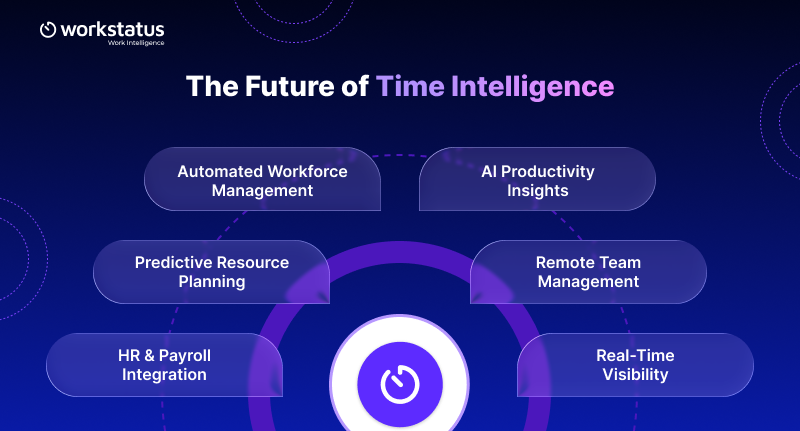
The future of Time Intelligence is driven by AI, automation, and real-time workforce analytics.
Here’s what you can expect:
- AI-powered productivity and utilization insights
- Automated workforce management and reporting
- Predictive analytics for resource planning
- Real-time operational and performance visibility
- Smarter integration with HR and payroll systems
- Enhanced management of remote and hybrid teams
Businesses are increasingly using intelligent time data to improve productivity, optimize operations, and make faster decisions.
Conclusion
Time Intelligence is transforming workforce management by turning time data into actionable business insights.
From improving productivity and payroll accuracy to optimizing billing and project utilization, it helps organizations operate more efficiently and make smarter decisions.
With real-time visibility, automation, and advanced analytics, solutions like Workstatus enable businesses to build more productive, transparent, and data-driven workplaces.
FAQs
What is Time Intelligence?
Time Intelligence helps you understand how work hours are spent across projects, clients, and teams. It helps you:
- Track productivity trends
- Measure utilization
- Improve profitability
Therefore, you can make better business decisions.
What is the difference between Time Tracking and Time Intelligence?
Time tracking records work hours, while Time Intelligence explains what those hours mean. It helps you:
- Understand work patterns
- Measure productivity
- Analyze project performance
Thus, you gain deeper insights than basic time tracking.
How does Time Intelligence help businesses?
Time Intelligence connects time data with business outcomes. It helps you:
- Increase billable hours
- Improve utilization
- Optimize resources
Therefore, teams become more productive and profitable.
Can Time Intelligence improve client billing?
Yes, it provides better visibility into billable work. It helps you:
- Capture billable hours
- Improve billing accuracy
- Reduce revenue leakage
Thus, client invoicing becomes more reliable.
Is Time Intelligence useful for remote teams?
Yes, it helps managers understand how work happens across locations. It helps you:
- Review productivity trends
- Track utilization
- Improve workload planning
Therefore, remote teams stay aligned and efficient.
Which industries can benefit from Time Intelligence?
Time Intelligence is useful for businesses that manage people, projects, and billable work, including:
- IT companies
- Digital agencies
- Consulting firms
- KPO & BPO companies
- Architecture & design firms
Thus, these businesses gain better visibility into productivity, utilization, and profitability.