Table of Contents
Ten hours online doesn’t always mean ten hours of progress. We pulled together these employee productivity statistics to show where paid time turns into results. And where it doesn’t.
In a service business, time is the product you sell. Hours feed payroll and back up client invoices.
But hours alone can’t tell you if a project stayed on budget. That’s why more teams now measure outcomes along with time.
Most of this year’s research lands in the same place. People are working the hours. The results aren’t keeping up.
Productivity growth
1. US total factor productivity grew 0.8% in 2025
Total factor productivity tracks how much output a business gets from everything it puts in.
As per the U.S. Bureau of Labor Statistics, output grew 2.6% in 2025. Inputs grew by just 1.7% over the same period.
So most of that growth came from better ways of working. Businesses didn’t simply throw more at the problem.
2. Labor productivity rose 2.5% from Q2 2025 to Q2 2026
Labor productivity is simply output per hour worked. As per the BLS, output climbed 2.5% while hours barely moved, up just 0.2%.
In other words, the economy got more done without working longer. Expect your clients to want the same from you.
3. Labor productivity across OECD countries grew 1.2% in 2024
The OECD Compendium of Productivity Indicators 2026 says that’s double the 2023 rate. Still, just 11 member countries grew faster than they did before the pandemic.
Most countries still grow slower than they did before 2020. Buying new tools won’t fix that by itself. How you organize the work makes a bigger difference.
Employee engagement
Big-picture growth can hide a people problem. These employee productivity statistics show engagement going down, and output tends to follow.
By engaged, we mean people who feel part of their work and care how it turns out.
4. Only 1 in 5 employees worldwide felt engaged in 2025
As per Gallup’s State of the Global Workplace 2026 report, engagement slipped to 20%. That’s two years of decline in a row and the lowest figure since 2020.
Put simply, four out of five people on your payroll might be doing the bare minimum. A full timesheet won’t tell you that.
5. Low engagement costs the world economy about $10 trillion
Gallup’s same report puts that at roughly 9% of global GDP.
Teams that have checked out miss more deadlines and make more mistakes. With clients, that usually means rework you can’t bill for.
6. Manager engagement dropped to 22% in 2025
According to Gallup, manager engagement has fallen by nine points since 2022. This drop has occurred mainly over one year; from 27% to 22%.
Your team will follow your lead as a manager. If you’re no longer engaged, your team’s timesheets won’t be approved and nobody will look at their records.
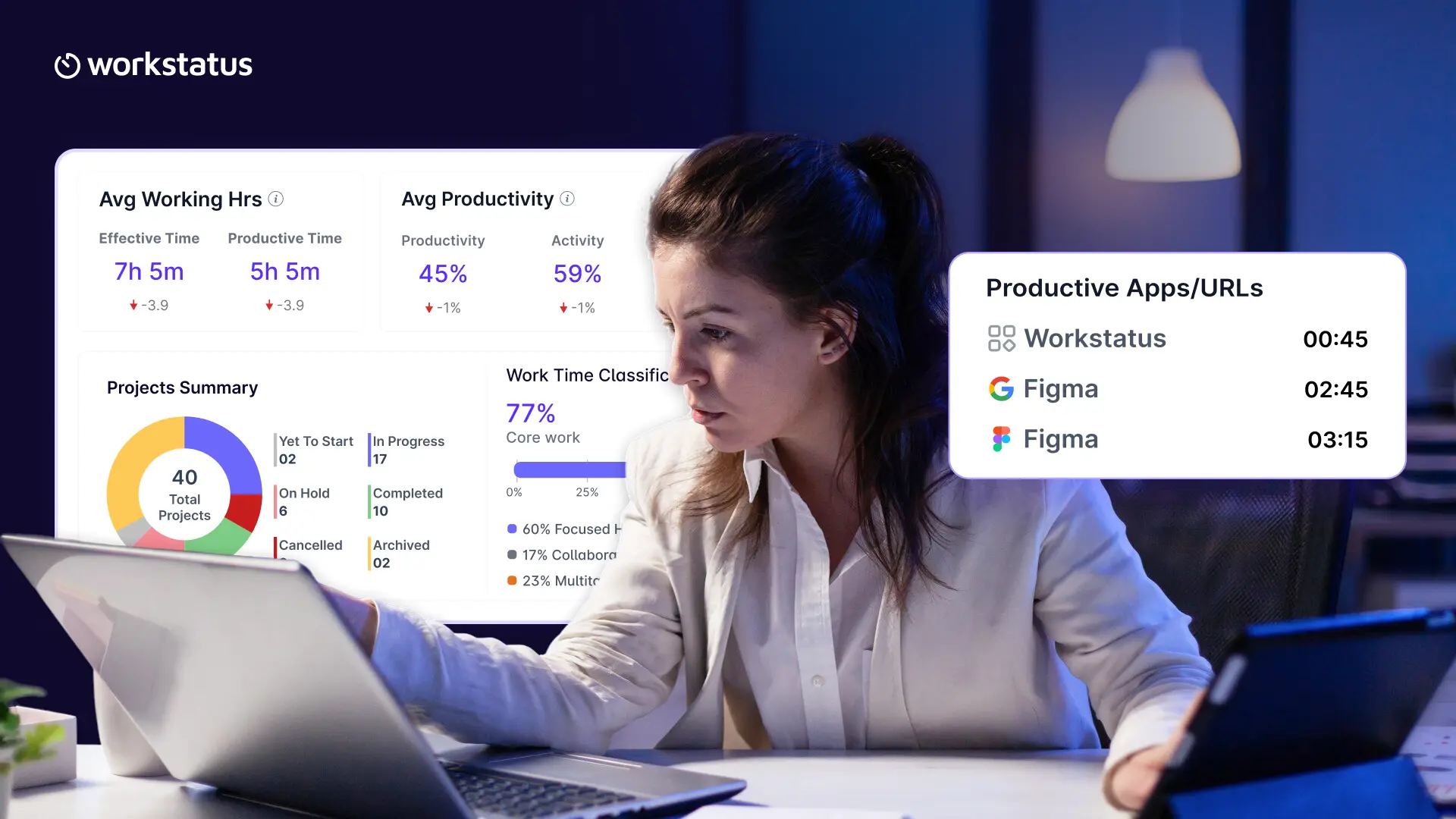
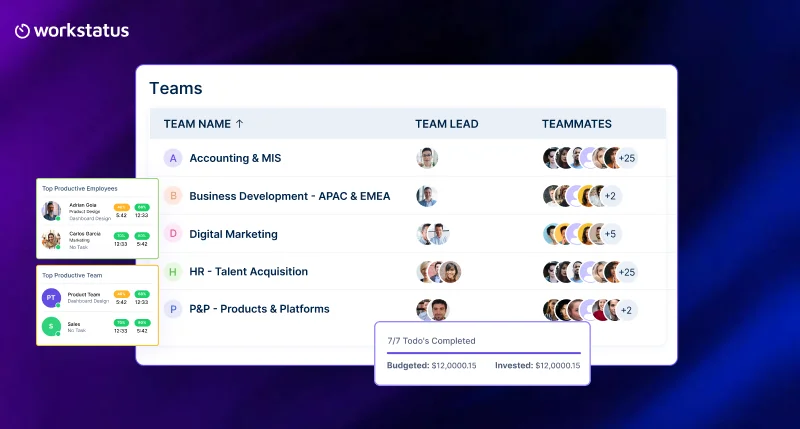
Workstatus helps you stay connected with team activity and timesheet progress. Use Workforce management software to improve work visibility and keep daily operations on track. Give your team the support and direction they need to perform better.
Remote and hybrid work
Where people work matters less than most teams think. Flexible setups can keep output steady, and they help you hold on to good people.
7. Industries with more remote workers saw stronger productivity growth
BLS researchers looked at 61 private sector industries between 2019 and 2021. For every 1 point rise in remote work, total factor productivity went up by 0.08 points.
Output doesn’t depend on location. It depends on having clear records wherever people work. Good remote workforce management for IT services and agency teams starts there.
8. Hybrid work cut quit rates by one third
In a randomized trial published in Nature, 1,612 employees worked from home two days a week. Two years of performance reviews later, their grades hadn’t changed.
A randomized trial puts people into groups by chance, which keeps the test fair.
Every time someone quits, you lose hiring time and ramp-up time. Flexible work helps you keep trained people on client projects.
AI and productivity
AI is part of most people’s workday now. The gains aren’t even, though. And the tool itself is rarely the reason.
9. Productivity growth nearly quadrupled in industries most exposed to AI
PwC’s 2025 Global AI Jobs Barometer also found 3x faster growth in revenue per employee in these industries. That’s 27% against 9% for the industries least exposed to AI.
Software and customer service work are among the first to change. So IT services and BPO teams stand to gain the most.
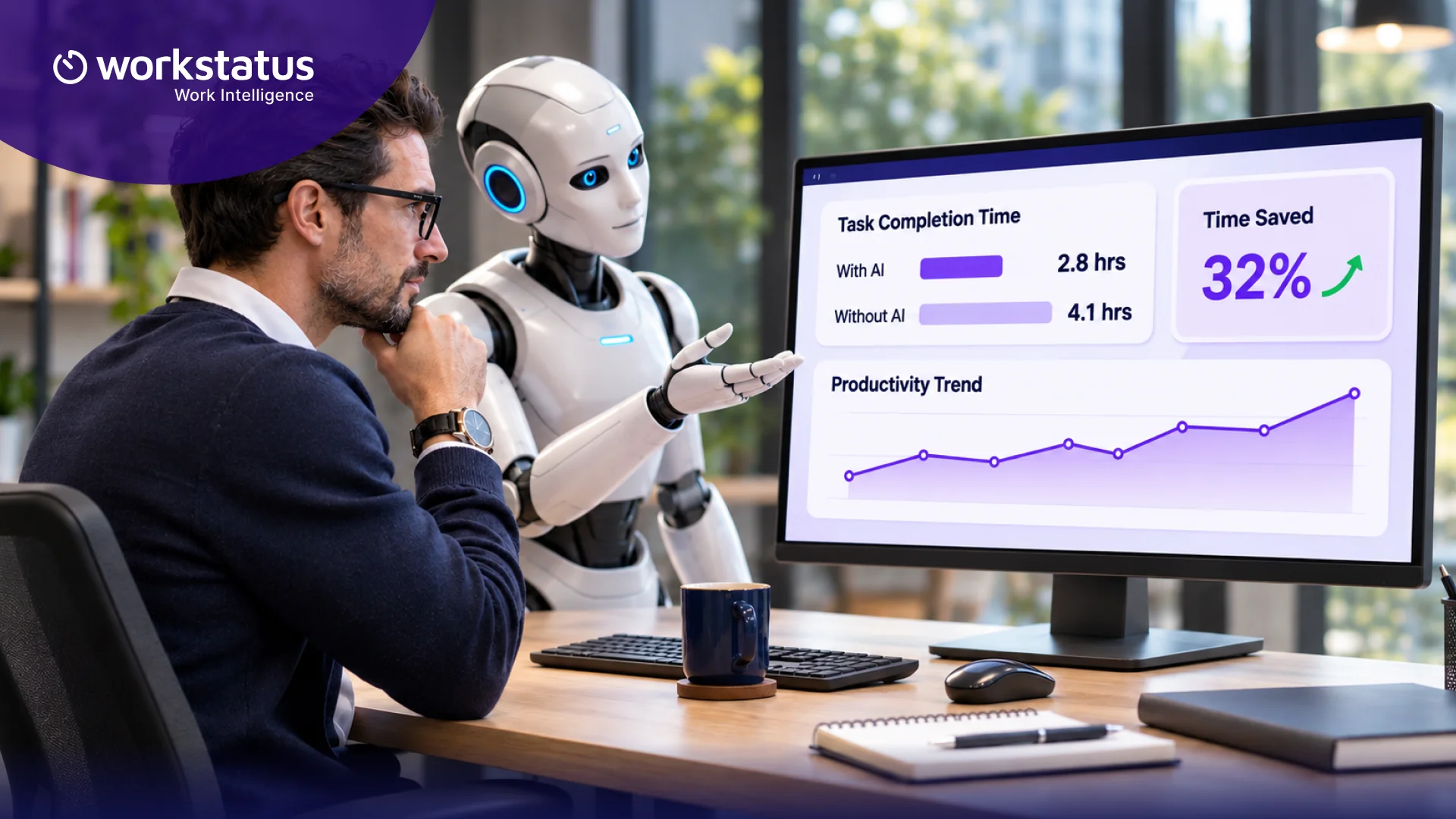
10. Generative AI saves users about 2.2 hours a week
The Federal Reserve Bank of St. Louis says that’s 5.4% of a user’s work hours. Spread across all workers, the savings drop to 1.4% of total hours. That works out to about a 1.1% boost in productivity.
An hour saved doesn’t mean much until it becomes finished work.
The real value lies in knowing where those saved hours go and what they help your team achieve.
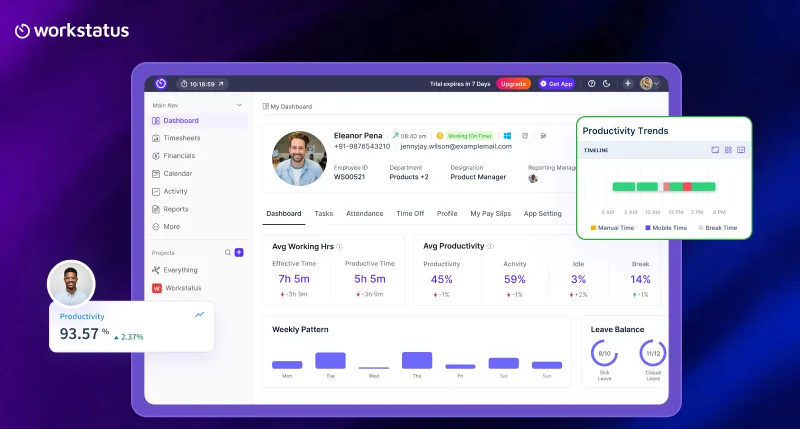
AI can save time. But teams need visibility to turn those savings into real results. Workstatus helps you track work patterns and understand how AI affects team output. Use workforce productivity software to identify gaps and improve how your team spends its time.
Interruptions and meetings
Whatever time AI saves can disappear just as quickly. A few minutes here and there add up by Friday.
11. Employees face about 275 interruptions a day
Microsoft’s 2025 Work Trend Index special report puts it at roughly one ping every two minutes during core hours.
12. 57% of meetings happen without a calendar invite
The same Microsoft report says these are mostly ad hoc calls. Since no one plans them, no one protects the time around them either.
13. 71% of senior managers say meetings are unproductive
In a Harvard Business Review survey of 182 senior managers, 65% also said meetings got in the way of their own work. Every lost minute comes out of the hours you’re paying for.
14. 53% of executives say productivity must rise, yet 80% of workers say they lack the time or energy
That gap comes from Microsoft’s 2025 Work Trend Index, which surveyed workers around the world.
Stress and wellbeing
When a team stays stretched for too long, it starts to show. First in people’s health, then in their work.
15. 77% of workers felt work stress in the past month
In the American Psychological Association’s 2023 Work in America Survey, 57% said the stress had hurt them. Many felt drained or unmotivated.
16. Every $1 spent on treating common mental health conditions returns about $4
The World Health Organization estimates depression and anxiety cost around 12 billion working days a year. That’s close to US$1 trillion in lost productivity.
Final thoughts
Most of these numbers say the same thing. How you set up work matters more than how many hours people log.
But you can’t fix what you can’t see. Workstatus is a workforce intelligence software that links each hour to real work, so you catch problems early.
Start small. Pick one project this week and check where its hours went.
FAQs
1. What is workforce productivity?
Ans. Workforce productivity measures how much work your team delivers for the hours it puts in. Hours show effort, but output shows the real value.
2. Does AI improve workforce productivity?
Ans. It can, but only when companies change how work gets done. McKinsey found 88% of firms use AI, yet only 39% see any impact on profit.
3. How can you measure workforce productivity?
Ans. Track hours against the projects or client accounts they serve, then compare them with what each team delivered. Workstatus links every hour to real work, so you can spot gaps early.
4. Does remote work lower productivity?
Ans. No. BLS research found that industries with more remote work saw stronger productivity growth. A randomized trial in Nature also found that hybrid workers kept the same performance grades as office workers.
5. Why does employee engagement affect productivity?
Ans. Engaged people care about the results of their work. Disengaged teams miss more deadlines and make more mistakes. Gallup estimates that low engagement costs the world economy about $10 trillion a year.