
Table of Contents
Overtime – the extra hours we invest in our work can be both a boon and a bane.
For employees, it often translates to increased income and an opportunity to demonstrate dedication.
On the other hand, employers rely on overtime to meet project deadlines and enhance productivity.
Yet, managing overtime efficiently can be complex, requiring precision and adherence to labor laws.
In this blog, we’ll introduce you to the ultimate solution for overtime management, the Overtime Calculator, unveiling its incredible benefits, functionality, and how it can revolutionize how you approach your work and finances.
How to Calculate Overtime (Step-by-Step Guide)
If you’re wondering how to calculate overtime, the process is simple. Overtime is calculated by multiplying the overtime hours worked by the overtime rate, which is typically 1.5 times the regular hourly rate.
Overtime Formula:
Overtime Hours × Regular Hourly Rate × Overtime Multiplier (1.5)
This overtime calculation method is commonly used in countries where employees receive 1.5x their standard rate for hours worked beyond 40 hours per week.
Overtime Calculation Example
Let’s understand how overtime calculation works with a practical example:
- Regular hourly rate: $20 per hour
- Total hours worked in a week: 45 hours
- Standard workweek: 40 hours
Step 1: Calculate Overtime Hours
45 − 40 = 5 overtime hours
Step 2: Apply the Overtime Rate
5 × $20 × 1.5 = $150
In this example, the employee earns an additional $150 for the 5 extra hours worked beyond the standard 40-hour workweek.
This structured overtime calculation ensures accuracy, compliance with labor laws, and proper tracking of extra hours worked.
Common Causes Of Overtime
1. Deadline Pressure
Projects with tight deadlines often require employees to work extra hours to meet time-sensitive goals.
2. Staff Shortages
Insufficient staffing can increase workloads, forcing employees to work extra hours.
3. Unplanned Workload
Unexpected tasks or urgent issues can disrupt regular work schedules and result in overtime.
4. Inefficient Processes
Inefficient work procedures and lack of automation can slow down productivity, necessitating extra time.
5. Client Demos
High-maintenance clients or customers may require additional attention and work hours.
These are some common causes of overtime. No matter the reason, accurate tracking of overtime hours is essential for payroll accuracy and compliance. This is where the Overtime Calculator helps simplify the process.
Benefits Of Using The Overtime Calculator
1. Efficiency
The Overtime Calculator eliminates the need for manual calculations or reliance on potentially inaccurate tools. This saves time and reduces errors, ensuring employees receive fair compensation for overtime hours. It also integrates seamlessly with payroll software to ensure accurate payroll processing without manual adjustments.
2. Compliance
With its precise calculations, the Overtime rate Calculator ensures compliance with labor laws in various countries. It considers local regulations and applies them accurately to determine proper overtime.
3. Transparency
The calculator’s transparent calculations promote trust and fairness between employers and employees by providing a clear breakdown of the calculations used.
Now that we’ve explored the common causes of overtime, let’s delve into how you can efficiently calculate and manage overtime using the Workstatus Overtime Calculator.
Workstatus’s Overtime Calculator
Workstatus Overtime Calculator is a free online tool that helps you calculate overtime for both hourly and salaried employees.
To use the Workstatus overtime calculator, simply follow the following steps: Here is an example for a better understanding
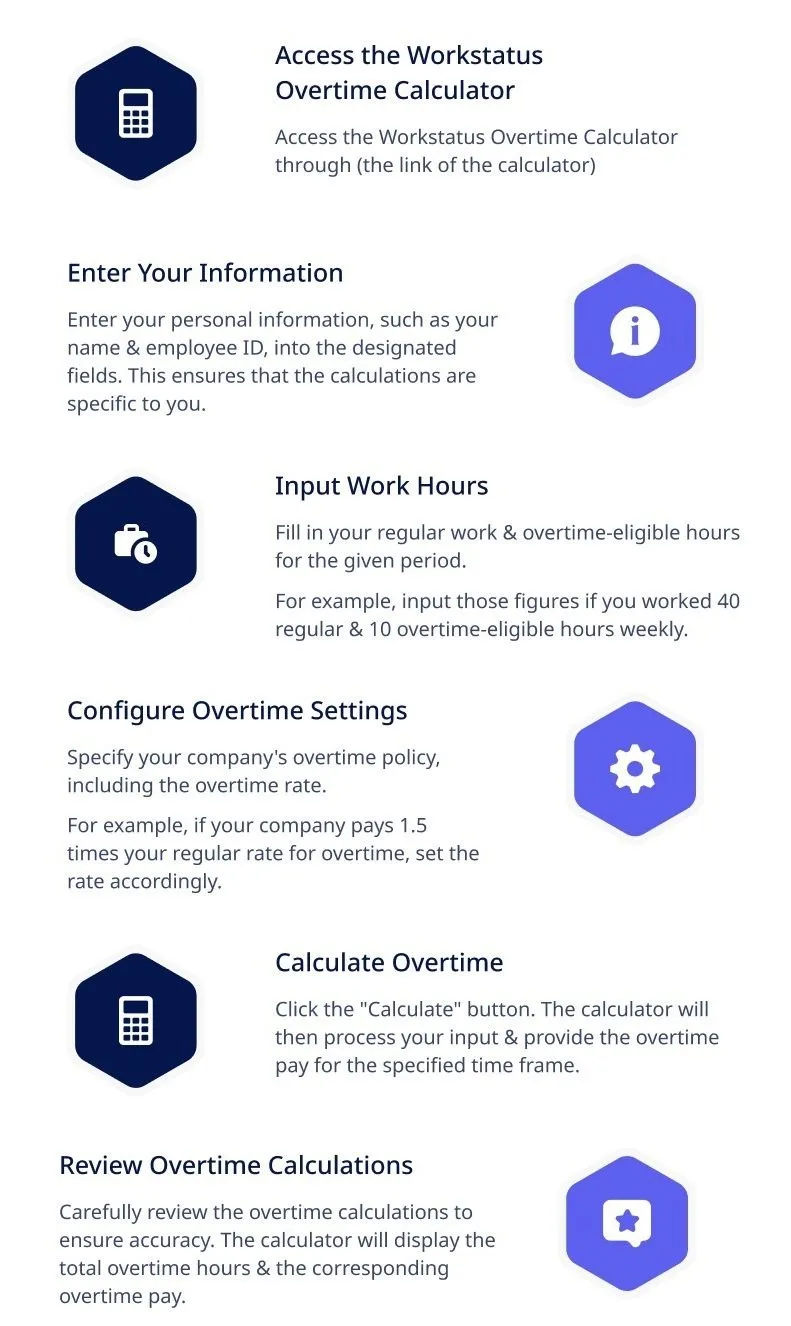
Suppose you worked 40 regular hours at $20 per hour & 10 overtime-eligible hours at 1.5 times the regular rate. You would enter the following details:
- Regular Hours: 40
- Overtime-Eligible Hours: 10
- Overtime Rate: 1.5 (indicating 1.5 times the regular rate)
Upon calculating, the tool will show you have 10 hours of overtime & $300 in additional overtime pay (10 hours x $20 x 1.5).
When it comes to using the Workstatus Overtime Calculator, it’s not just about the basic calculations.
Laws & Regulations With Overtime:
1. Fair Labor Standard Act (FLSA) – United States
- The FLSA states that non-exempt employees in the United States are entitled to overtime pay at a rate of 1.5 times their regular hourly wage for all hours worked beyond 40 hours in a workweek.
- It sets a federal minimum wage & establishes overtime regulations for employees covered by the act.
2. European Working Time Directive – European Union
- This directive applies to EU member states & limits the average working week to 48 hours, including overtime, over a reference period.
- It ensures a minimum daily rest period & a minimum weekly rest period & limits excessive night work.
3. Australian Fair Work Act
- In Australia, overtime regulations vary by industry & occupation, but the Fair Work Act generally makes overtime pay for working outside standard hours.
- The Act includes provisions for maximum weekly working hours, rest breaks, & compensation for overtime work.
Conclusion
Managing overtime has never been more efficient or data-driven.
Workstatus overtime rate calculator simplifies calculating overtime and empowers you to optimize productivity.
With real-time payroll, invoicing, and insightful reporting, you can make informed decisions and ensure your workforce is compensated fairly while maximizing productivity while operating overtime.
FAQs
Ques. How to calculate Overtime Rate per hour?
Ans. Your overtime rate is calculated by multiplying your regular hourly wage by 1.5. For example, if you earn $20 per hour, your overtime pay would be $30 per hour for hours worked beyond 40 in a week.
Ques. How to calculate overtime for monthly salary employees?
Ans. To calculate overtime for monthly salaried employees, divide the monthly salary by 30 to get the daily wage, then by daily work hours to get the hourly rate. Multiply the hourly rate by 1.5 (or the applicable rate) and by the overtime hours worked to get total overtime pay.
Ques. What are the two rules for calculating employee overtime?
Ans. There are two main overtime rules: employees earn 1.5 times their regular pay for hours worked beyond 40 per week, and in some regions, overtime applies after 8 hours in a single day.
Ques. What is the fastest way to calculate overtime for multiple employees?
Ans. The fastest way is to use an online overtime calculator or time tracking software that automatically calculates overtime based on total hours worked. This eliminates manual calculations and reduces compliance risks.
Ques. How can overtime tracking improve productivity?
Ans. Overtime tracking helps identify overworked teams and workflow issues. It allows managers to balance workloads and improve efficiency.