
Table of Contents
Ever feel like your team is busy, but profitability is still inconsistent?
This is a very common challenge for many IT service teams: they work at full capacity, yet the stronger margins don’t always follow.
In service businesses, utilization plays a very important role in profitability. When team capacity is aligned with billable work, it directly helps businesses to:
- Improve margins and make revenue more predictable
- Reduce idle time and bench costs
- Deliver projects faster and improve client satisfaction
- Plan hiring and capacity more effectively
But without clear benchmarks and real-time visibility, it becomes difficult to know if your teams are really productive or just busy.
In this blog, you’ll explore utilization benchmarks, how to improve utilization rate in IT services, and simple ways to improve team productivity for sustainable growth.
Let’s go!!!
Key Utilization Benchmarks in the IT Industry
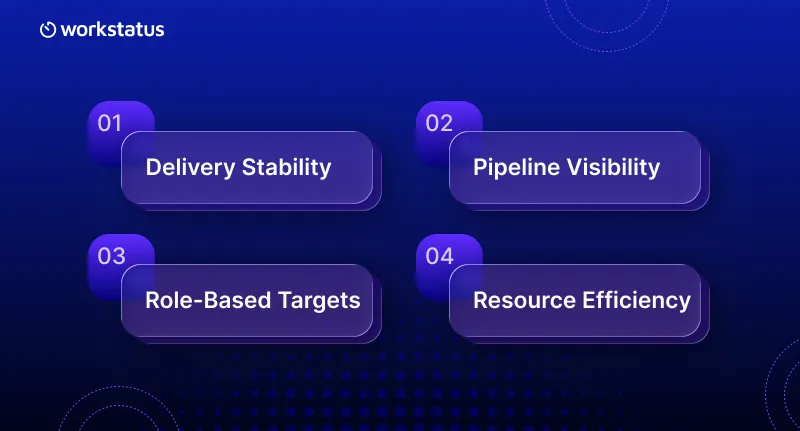
Are your IT service billable utilization levels aligned with what high-performing IT services firms are achieving today? Tracking the right benchmarks can help you identify gaps and take timely action.
- Are your teams operating within the 70%–85% industry utilization range?
- Is your organization maintaining 75%–80% utilization for stable delivery performance?
- Are you strategically pushing 80%+ utilization through better pipeline visibility?
- Have you defined different utilization targets for consulting vs delivery roles?
- Are you using offshore or hybrid models to improve resource efficiency?
Regularly evaluating these benchmarks helps leaders make smarter workforce and profitability decisions.
Relationship Between Utilization and Profitability
Is your current utilization level truly strengthening your margins or just keeping teams occupied?
Here’s why utilization plays a direct role in your profitability outcomes:
- Higher utilization helps increase revenue without adding immediate costs
- Optimal utilization improves gross margins and financial stability
- Low utilization leads to bench costs and reduced revenue per employee
- Excessive utilization may impact delivery quality and team sustainability
- Balanced utilization supports predictable profitability and scalable growth
When utilization is strategically managed, it becomes a powerful lever for improving both short-term performance and long-term business success.
Factors That Influence Utilization Rates
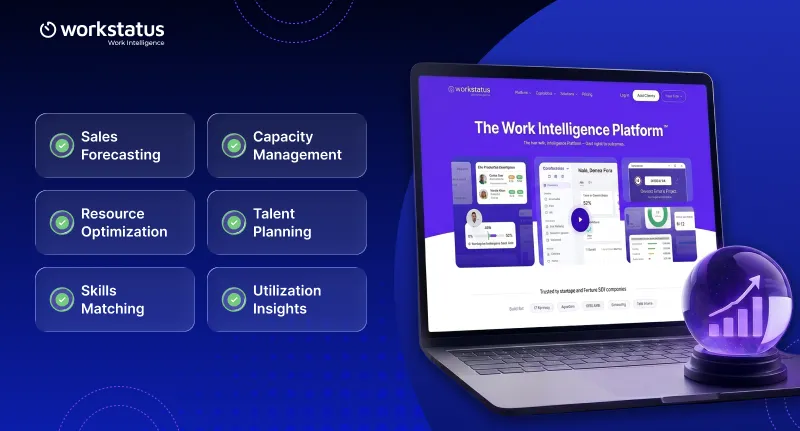
Utilization levels don’t fluctuate randomly; they are shaped by several operational and strategic decisions.
Here’s why some IT services firms consistently maintain healthier utilization than others:
- Sales pipeline visibility improves accuracy in future resource planning
- Efficient resource allocation helps teams transition faster to billable work
- Strong skill-to-project alignment supports consistent utilization levels
- Project delays or scope changes can increase temporary bench capacity
- Strategic hiring and reskilling sustain long-term utilization balance
- Real-time workforce insights enable proactive utilization improvements
By strengthening these areas, organizations can build more stable utilization patterns and improve overall profitability predictability.
Creating a Utilization Intelligence and Reporting System
A structured reporting framework helps IT services leaders move from reactive staffing decisions to data-driven utilization planning.
Here’s how organizations can build stronger utilization intelligence:
- Define clear utilization KPIs such as billable %, realization rate, and revenue per employee
- Implement real-time dashboards to track team capacity and productivity trends
- Standardize reporting cycles for weekly and monthly utilization reviews
- Integrate sales pipeline data with workforce planning insights
- Use historical utilization data to improve forecasting and hiring decisions
- Enable leadership visibility into utilization performance across projects
Building a utilization intelligence system helps organizations improve decision speed, margin control, and delivery predictability.
Enhancing Resource Productivity and Visibility with Workstatus
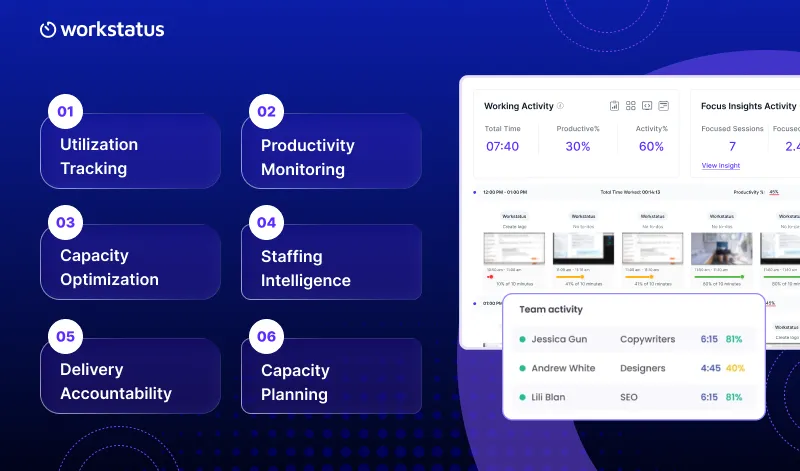
Improving utilization requires more than planning; it demands real-time visibility into how teams spend their productive hours.
Here’s how workforce intelligence tools like Workstatus can support better utilization outcomes:
- Track billable vs non-billable time to improve utilization accuracy
- Monitor real-time productivity trends across teams and projects
- Identify idle capacity early to enable faster resource redeployment
- Access performance dashboards for data-driven staffing decisions
- Improve accountability and delivery efficiency through transparent reporting
- Support smarter capacity planning with actionable workforce insights
By strengthening productivity visibility, organizations can optimize resource deployment and drive more consistent profitability.
The Measurable Impact of Utilization Optimization
Utilization optimization delivers tangible, data-backed results across profitability and delivery performance.
Here’s why focusing on utilization intelligence creates measurable business impact:
- Improving utilization by 5–10% can increase operating margins by 8–15%
- Real-time billable utilization rate for IT services can reduce bench costs by 10–20% annually
- Data-driven planning may improve revenue per employee by 8–12%
- Faster resource allocation can shorten project start cycles by 20–30%
- Strong utilization governance helps increase billable realization rates by up to 25%
- Predictive analytics can help companies forecast workforce needs more accurately by 30–40%.
These outcomes highlight how utilization improvements directly translate into stronger financial stability and scalable growth.
Future Trends in IT Services Utilization
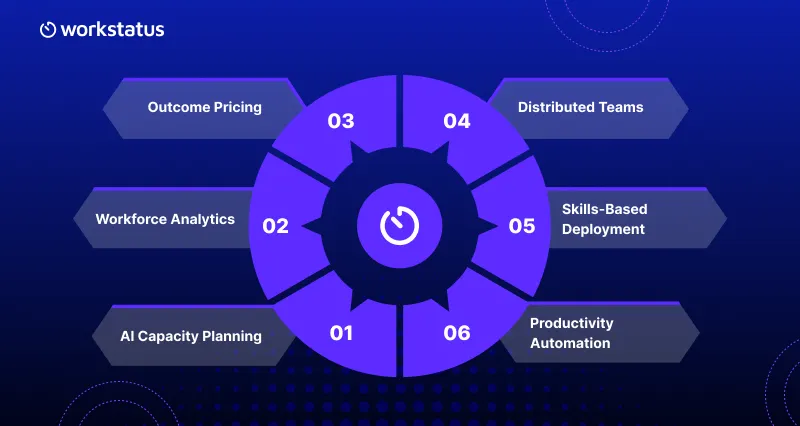
Utilization management in IT services is rapidly evolving as organizations adopt smarter workforce strategies and advanced technologies.
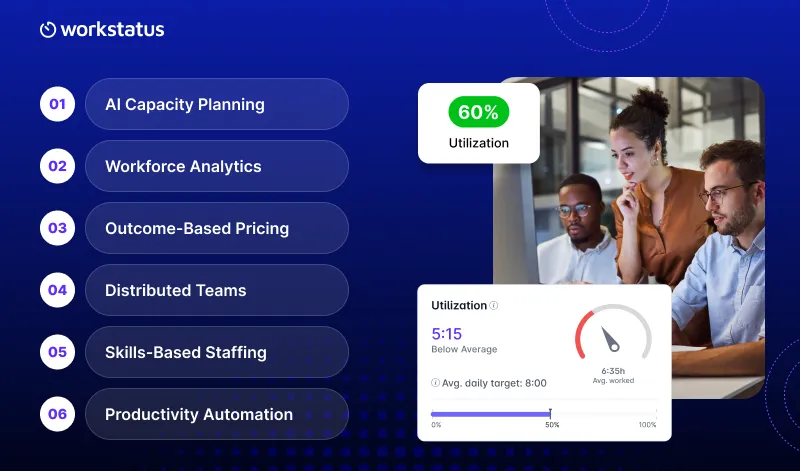
Here’s what the future of utilization optimization is likely to focus on:
- AI-driven capacity planning to predict demand and optimize staffing decisions
- Real time tracking & workforce analytics for continuous utilization monitoring
- Outcome-based pricing models are shifting focus from hours to value delivered
- Hybrid and distributed delivery teams are improving global utilization flexibility
- Skills-based workforce deployment enabling faster project alignment
- Automation and productivity tools help teams work faster and use more billable time.
As these changes happen in the industry, IT services companies that improve how they manage utilization will be better able to increase margins, strengthen project profitability for IT services, and grow steadily.
Final Thoughts
Take control of your utilization strategy to improve margins, strengthen delivery outcomes, and drive sustainable IT services growth.
Use real-time Work Intelligence with Workstatus to make faster resource decisions, increase billable efficiency, and build a more predictable, scalable business.
FAQs
Ques: What is a good utilization rate for IT services companies?
Ans: A good utilization rate is usually between 75% and 85%. It can change based on the type of work and delivery model.
Ques: How does utilization affect profits?
Ans: When more team time is billable, companies earn more revenue and improve margins.
Ques: Why do IT services companies face low utilization?
Ans: Low utilization can happen due to a poor sales pipeline, a wrong skill match, project delays, or weak planning.
Ques: How can companies improve workforce utilization?
Ans: They can improve it by planning demand better, tracking productivity in real time, and assigning resources faster.
Ques: How do workforce analytics tools help utilization?
Ans: These tools help leaders see billable capacity, team productivity, and staffing gaps, so they can make quicker decisions.