
Table of Contents
Your team is working around the clock. Calendars are packed. Slack is buzzing. Everyone is exhausted.
Yet when the quarter closes and financial results arrive, the story is different. Profit margins are thin, flat, or shrinking even with high billable work.
This is one of the biggest challenges in professional services today: teams are working harder, but profits are not growing at the same pace.
The most profitable agencies are not the busiest ones. They are the ones who clearly understand how time, effort, and resources convert into revenue. Many teams stay fully occupied, but profitability does not improve. This is a key reason why busy teams are not profitable.
According to Promethean Research’s 2026 State of Digital Services Survey, agencies with over 50 employees average only about an 8% net profit margin. Many firms also fail to track project-level margins. As a result, they lose around 15% to 30% of potential profit due to hidden inefficiencies.
The Real Issue: Gap Between Work and Profit
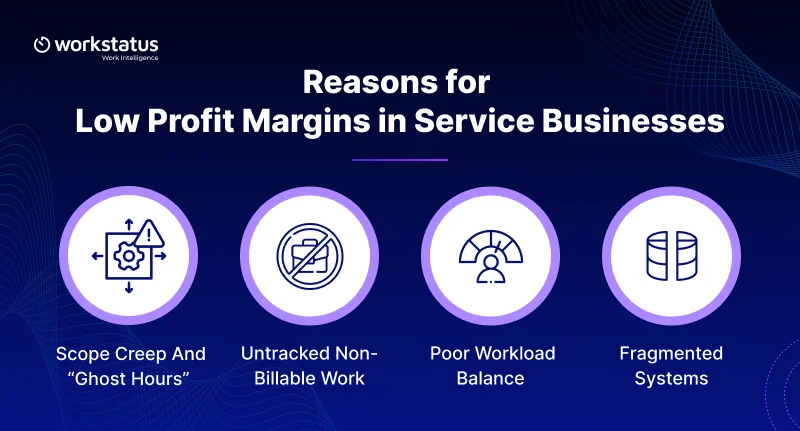
Most companies track project progress, but do not track how work actually happens. This creates a blind spot. Small inefficiencies grow over time and reduce margins, one of the main reasons for low profit margins in service businesses.
1. Scope Creep and “Ghost Hours”
Clients often request small changes or extra revisions. Teams usually accept them without recording time or updating the scope. These small tasks add up but are not billed.
2. Untracked Non-Billable Work
A large part of the day goes into meetings, coordination, updates, and admin work. According to Asana’s Anatomy of Work Index, knowledge workers spend about 60% of their time on “work about work,” leaving only 40% for real delivery.
This directly reduces project profitability.
3. Poor Workload Balance
Some employees are overloaded while others are underutilized. This imbalance increases cost, slows delivery, and creates burnout.
4. Fragmented Systems
Project data, time tracking, and financial data are often disconnected. This makes margin tracking slow and reactive instead of real-time.
Why Utilization Matters More Than Hours
Many managers think busy schedules mean high efficiency. But profitability depends on how well time is used, not how much time is spent. This is central to why utilization matters for profitability.
| Utilization Level | Impact |
| Below 55% | High cost from unused capacity |
| 55%–65% | Weak pricing power |
| 70%–85% | Healthy and profitable |
| Above 90% | Burnout and high turnover |
Frequent switching between tasks also reduces productivity due to lost focus time.
How High-Margin Teams Work Differently
High-performing teams do not focus on keeping people busy. They focus on using time effectively. This is key to how to increase profit margins in service businesses.
They track:
- Billable vs non-billable work
- Workload balance using team utilization tracking
- Project effort compared to revenue
Their goal is to turn workforce effort into profitable outcomes through better visibility, allocation, and utilization.
Workstatus: Turning Visibility Into Profitability
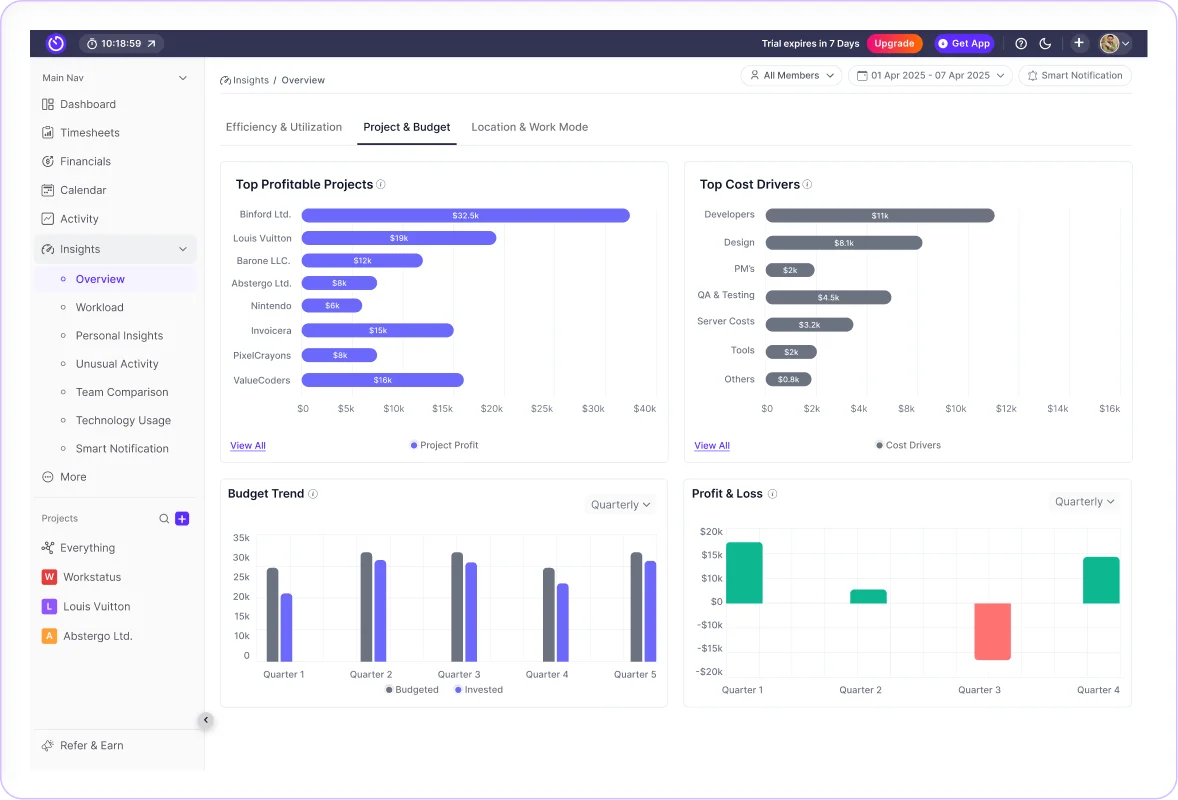
Improving margins is not about adding more processes. It is about improving visibility into work.
Workstatus helps service businesses do this by acting as workforce intelligence software.
It supports:
- Accurate time tracking
- Clear utilization visibility using resource utilization software
- Workload balance insights
- Real-time comparison of effort vs revenue
It also works as:
- workforce analytics software
- work intelligence software
- project margin tracking software
This helps businesses:
- Reduce scope creep losses
- Improve resource allocation
- Balance workloads
- Take corrective action early
- Strengthen project profitability
Conclusion
Most agencies do not lose profit because they lack work. They lose profit because they cannot see how work connects to revenue. When teams improve visibility, balance workloads, and track real effort, margins improve naturally. This is the real answer to why profitable teams lose money. The goal is not more work; it is better use of every hour worked.
FAQs
1. Why do profitable teams lose money even when they are busy?
Ans. Teams stay busy but lose money when work is not tracked properly. A lot of time goes into non-billable or low-value tasks. This is a core reason why profitable teams lose money.
2. Why are busy teams not profitable?
Ans. Busy teams are not always profitable because effort does not equal revenue. Without proper tracking, time gets wasted on low-impact work and rework.
3. What are the reasons for low profit margins in service businesses?
Ans. Main reasons include:
- Scope creep
- Untracked non-billable work
- Poor workload balance
- No visibility into execution
These are common reasons for low profit margins in service businesses.
4. How does untracked work impact project profitability?
Ans. Untracked work reduces billable time. It increases the hidden effort that is not charged to clients. This directly lowers project profitability.
5. What is the difference between productivity and profitability?
Ans. Productivity is about how much work is completed. Profitability is about how much revenue the work generates. A team can be productive but still not profitable.
6. Why does utilization matter for profitability?
Ans. Profitability depends on how effectively time is used. High utilization without overload improves output and reduces waste. This is why utilization is critical to profitability in service businesses.
7. How can managers improve project profitability?
Ans. Managers can improve it by:
- Identifying billable and non-billable work
- Balancing workloads
- Reducing scope creep
- Using real-time visibility tools
This supports improving project profitability.
8. How can businesses protect project margins?
Ans. Businesses can protect margins by improving visibility into work. Using project margin tracking software and real-time insights helps prevent losses early. This is key to how businesses can protect project margins.
9. Can workforce analytics software help improve profitability?
Ans. Yes. Workforce analytics software helps record time, utilization, and workload patterns. It helps identify risks before they impact margins.
10. How does workforce intelligence software help reduce profit loss?
Ans. Workforce intelligence software provides real-time visibility into how work is done. It helps identify inefficiencies early and improves decision-making. This directly improves project profitability.